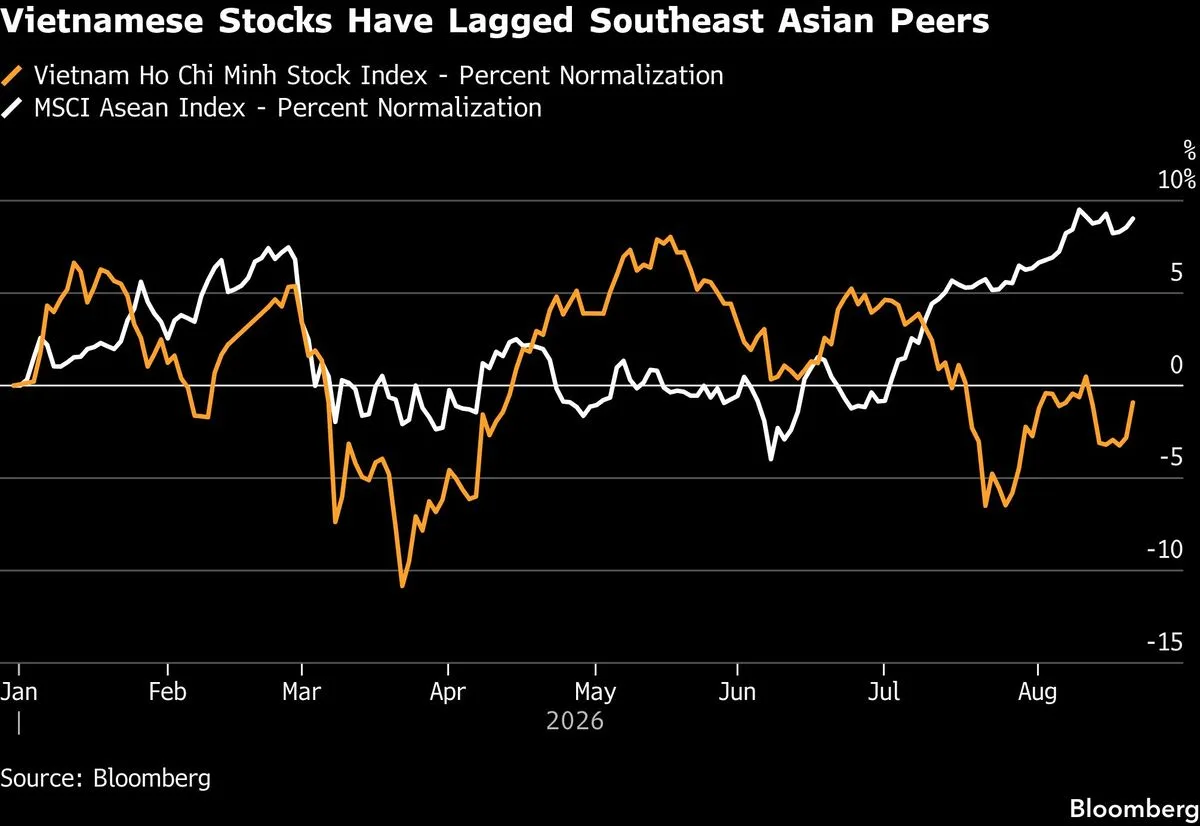
FTSE Russell announced on August 21, 2026, that it will add 27 Vietnamese stocks to its benchmarks, including the emerging-market gauge, effective September 21, 2026 [1, 2, 3]. This number exceeds the 23 stocks FTSE initially indicated in April 2026 [1, 2, 3].
The inclusion raises the weight of Vietnamese stocks in FTSE indices to 0.49%, above earlier projections [1, 2, 3]. Anthony Le, director at Vietcap Securities, said the increase means "index flows can now reach US$3 billion instead of US$2 billion previously," signaling heightened foreign investment interest [2].
Among the 27 companies added are major players such as Vingroup, Vinhomes, Hoa Phat Group, and Masan Group, spanning large-, mid-, and small-cap segments [2, 3]. Additionally, 90 more Vietnamese stocks will be included as micro-caps in FTSE indices but will not be part of the emerging-market benchmark [2, 3].
Vietnam secured an upgrade to secondary emerging-market status last year, confirmed in April 2026, paving the way for these index changes [2, 3]. Despite this, the Vietnamese market has seen persistent foreign investor selling exceeding $3 billion in 2026, causing the VN Index to underperform the broader MSCI ASEAN Index by its widest margin since 2022 [2, 3].
Following the FTSE update on Monday, August 24, the VN Index rose 1.4%, outperforming the MSCI regional gauge. Shares of Vingroup jumped 3.4%, with other major index additions also rising [2, 3]. Anthony Le added, "We believe the market will react positively to this news in the upcoming week" [2].
The index additions will be phased in gradually through September 2027 to allow passive inflows to build steadily rather than hitting the market all at once [2, 3]. Challenges remain for the Vietnamese market, including rising global oil prices due to Middle East tensions and a diamond scandal at Phu Nhuan Jewelry [2, 3].
Vietnam targets sustained annual GDP growth of 10%, maintaining its appeal for global emerging-market funds [2].