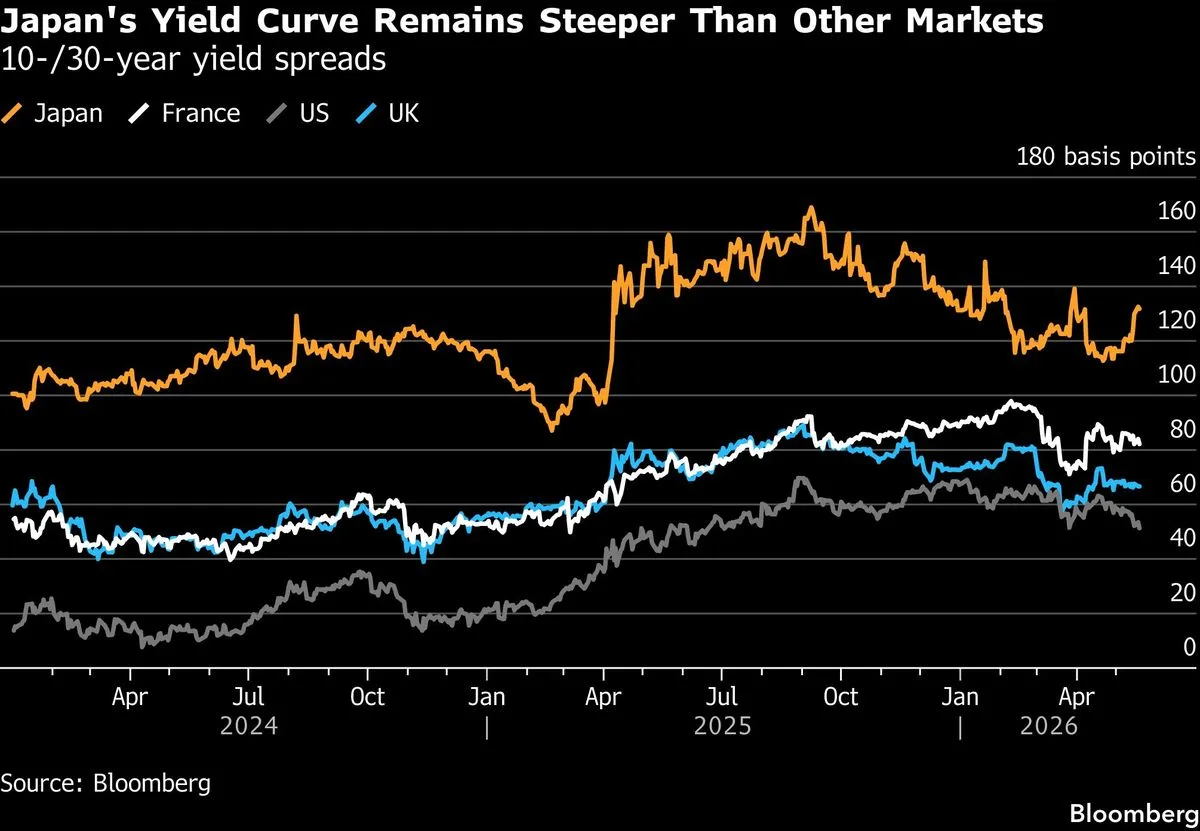
Japan’s long-term bond yields, especially on 30-year bonds, have surged to record highs due to inflation concerns and rising government spending as of May 2026 [1, 2, 3, 4, 5]. Pimco announced a bullish stance on Japan’s 30-year sovereign bonds while maintaining a bearish view on 10-year notes, citing a steep yield curve that it expects to narrow over time [1, 2, 3, 4]. Marc Seidner, Pimco’s chief investment officer of non-traditional strategies, said Japan’s yield curve has become "too steep" compared to other developed markets, creating "attractive value in longer-dated debt" [1, 2]. He added, "There is an excess risk premia that is attractive on an absolute basis and relative to many, many other markets" [3].
The spread between Japan’s 10-year and 30-year bond yields stood around 130 basis points as of May 20, down significantly from a peak of 171 basis points in September 2025 [2, 4]. This steepness contrasts with narrower spreads in the US (52 basis points) and UK (67 basis points) [2, 4]. The yield curve’s shape partly reflects market concerns that the Bank of Japan (BOJ) has been slow to raise interest rates amid inflation pressures and fiscal risks from increased government spending [2, 4]. Prime Minister Sanae Takaichi recently called for an extra budget to cushion the impact of rising commodity prices, fueling worries over Japan’s fiscal outlook [2, 4].
Japan’s economy grew faster than expected at the start of 2026, supporting further BOJ interest rate hikes [2]. However, rising long-term yields have put pressure on Japanese stocks. The Nikkei index declined 716 points on May 19 as bond yields approached 3%, raising concerns about the impact on corporate earnings [6, 5]. Kiyoshi Ishigane of Mitsubishi UFJ Asset Management said long-term yields above this level "would begin to place a tangible burden on the real economy" [6].
The BOJ began hearings on May 20 involving commercial banks, securities firms, and institutional investors to discuss the pace and scale of bond purchase reductions amid yield volatility [5]. There remains disagreement within the BOJ board over how quickly to reduce bond purchases while balancing market stability and the need to normalize bond market functions [5]. Recent strong demand at a 20-year bond auction briefly pulled down yields on 20- and 30-year bonds [2].
The BOJ hearings are scheduled to continue through May 21 as the central bank weighs next steps in managing Japan’s volatile bond market and yield curve dynamics [5].