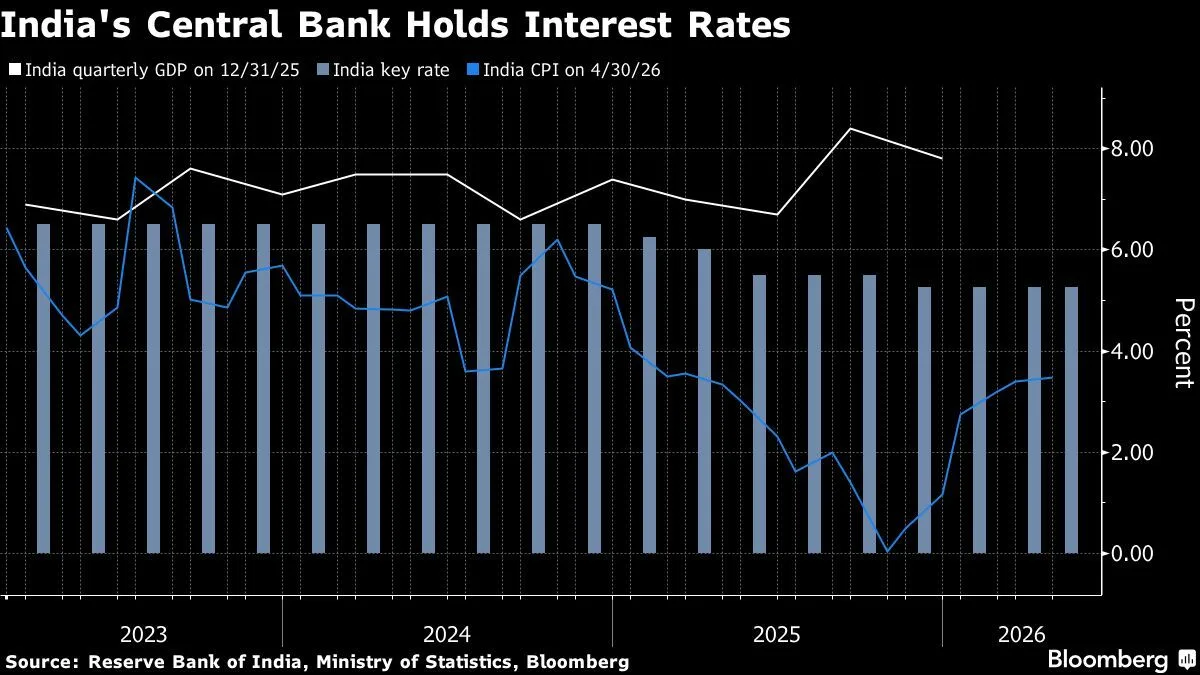
The Reserve Bank of India (RBI) kept its benchmark repo rate steady at 5.25% on June 5, 2026, maintaining a neutral policy stance following a unanimous decision by its Monetary Policy Committee (MPC) [1, 2, 3, 4, 5, 6]. The MPC agreed to wait for clearer inflation and economic data before adjusting rates further. RBI Governor Sanjay Malhotra said, "The MPC will continue to remain data dependent and closely monitor the developments, including supply side pressures getting embedded in the general price level and inflation expectations" [2].
India's April 2026 inflation rate was 3.48%, below the RBI's 4% target, but food inflation rose to 4.2%, up from 3.87% in March [4, 5]. The RBI raised its inflation forecast for the fiscal year ending March 2027 to 5.1%, up from the earlier estimate of 4.6% [2, 3, 5]. Meanwhile, the central bank cut its economic growth outlook for 2026-27 to 6.6%, down from 6.9% previously [2, 3, 5].
The Indian rupee weakened more than 6% year-to-date in 2026, trading near record lows around 95.7-95.8 per U.S. dollar at the time of the rate decision [1, 2, 4, 5]. To support the currency, the RBI has intervened in forex markets by selling dollars through state-run banks [2, 7, 4, 5]. The government is also considering tax cuts on foreign investments in government bonds in a bid to attract capital inflows and stabilize the rupee [2, 6].
Governor Malhotra noted that global factors were weighing on the outlook, stating, "Monetary policy has turned more cautious as the global economic outlook remains clouded by the geopolitical impasse in the Middle East" [4]. He added the RBI is prepared to ensure orderly forex market functioning amid these pressures [7, 5, 2].
Some economists expect the RBI to hike rates by 50 basis points starting in October 2026 to combat inflation risks. Venugopal Garre, head of India research at Bernstein, said a rate increase "could contain outflows at a time when currency depreciation has been the biggest pain point for policy makers" [2, 7].
The Reserve Bank of India is expected to review policy again in October 2026, with decisions likely dependent on evolving inflation data and currency market conditions.