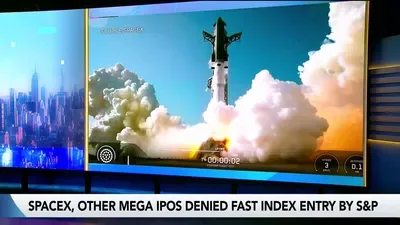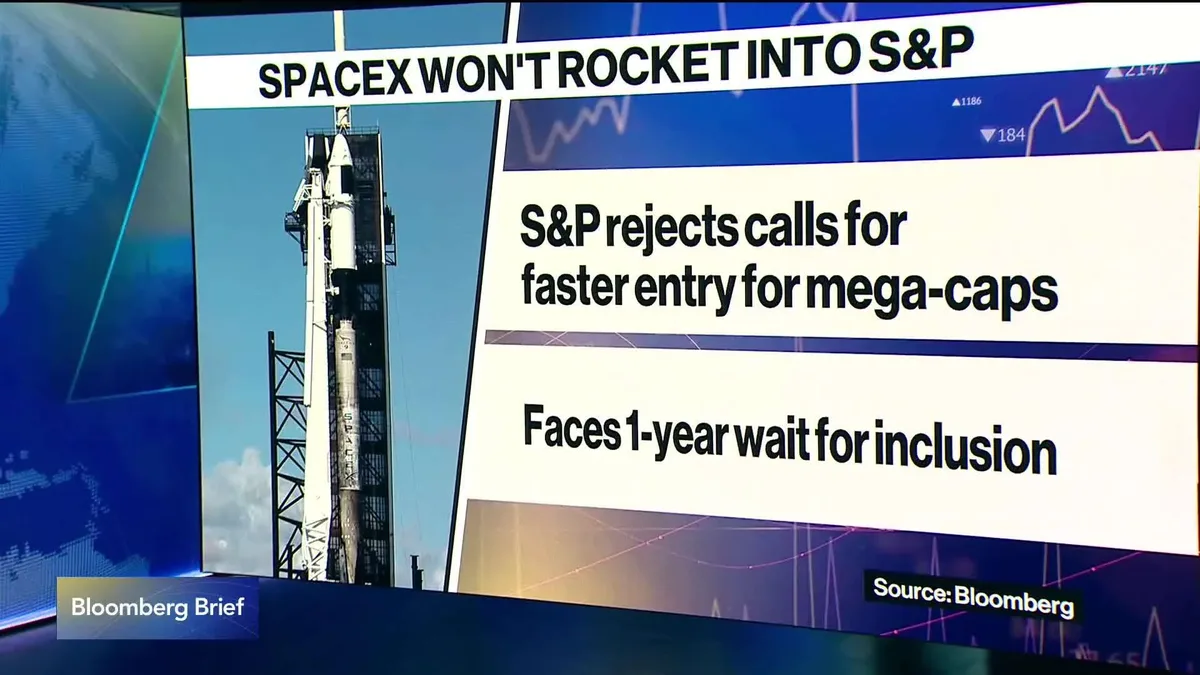
S&P Dow Jones Indices confirmed on June 4 that it will maintain its 12-month public trading seasoning period for new IPOs, effectively denying fast entry to mega-cap companies like SpaceX into the S&P 500 index [1]. S&P also reaffirmed that it will uphold its profitability requirements, requiring companies to report positive net income in the most recent quarter and in the prior four consecutive quarters before qualifying for inclusion [2, 1, 3, 4, 5].
SpaceX plans an IPO targeting a valuation around $1.75 to $1.8 trillion and aims to raise roughly $75 billion, potentially the largest IPO in history [2, 4, 6, 5]. However, SpaceX faces multiple hurdles for S&P 500 eligibility. Its expected public float is approximately 3% to 4%, which is below the S&P 500 minimum free float requirement of 10% [1, 5]. The company is currently unprofitable, with estimates projecting a net loss of $49.4 billion in 2025 and a debt load near $29 billion [1, 3, 5].
Consequently, SpaceX will need to wait at least 12 months after its planned IPO date of June 11, 2026, and meet the required profitability and float thresholds before it can qualify for the index [7, 2, 4, 6, 5]. Industry analysts expected more lenient rules, as rival index providers Nasdaq and FTSE Russell have eased entry standards for mega IPOs. Nasdaq allows inclusion in the Nasdaq 100 after just 15 trading days, while FTSE Russell permits entry after 5 trading days [2, 1, 4, 5].
James Seyffart, a Bloomberg Intelligence analyst, expressed surprise at S&P's decision, saying, "I am genuinely surprised. But S&P is the market leader and they can buck the trend" [2]. The firm’s choice to preserve stricter index rules aims to protect passive investors from volatility linked to early inclusion of large but immature IPOs [2, 1, 6].
SpaceX’s eventual inclusion in the S&P 500 likely will be delayed until mid-2027 or later, given the 12-month seasoning rule and expected timeline for profitability [3, 5]. If admitted with about a 5% free float and $2 trillion valuation, SpaceX could attract roughly $10 billion from passive funds, representing about 0.15% of the index weight [5].