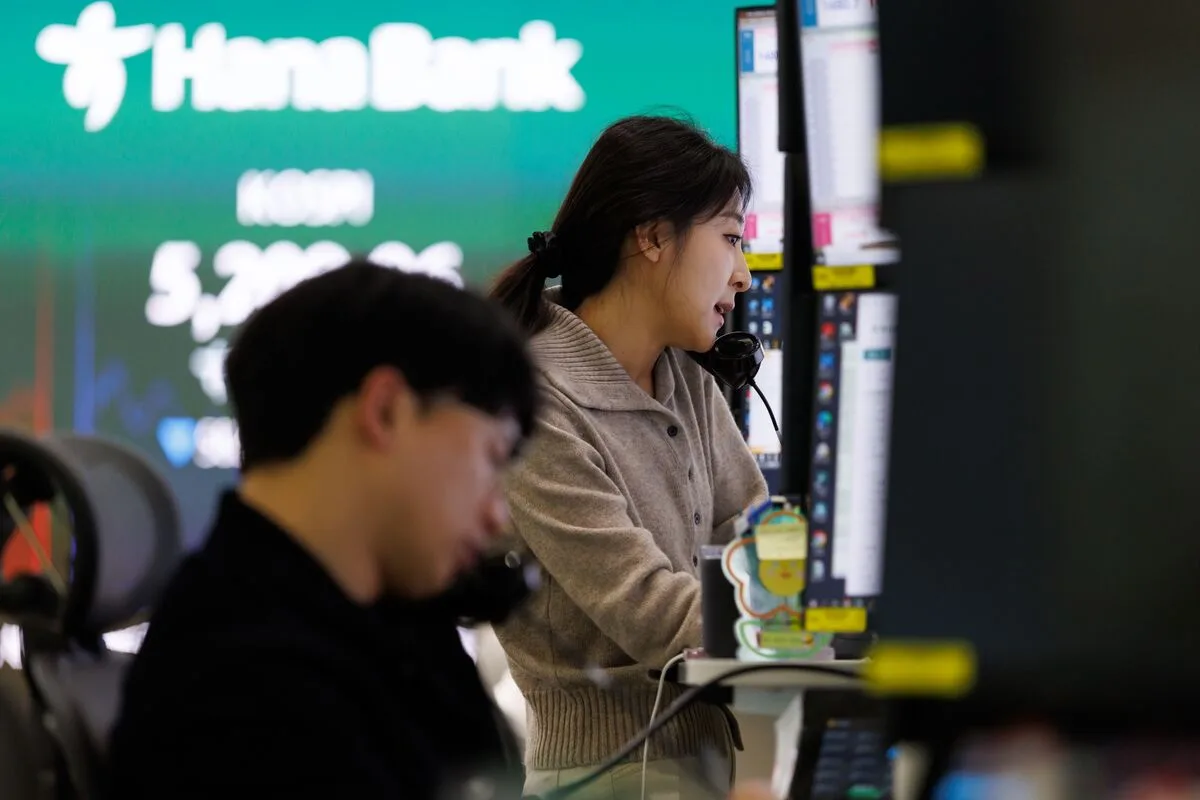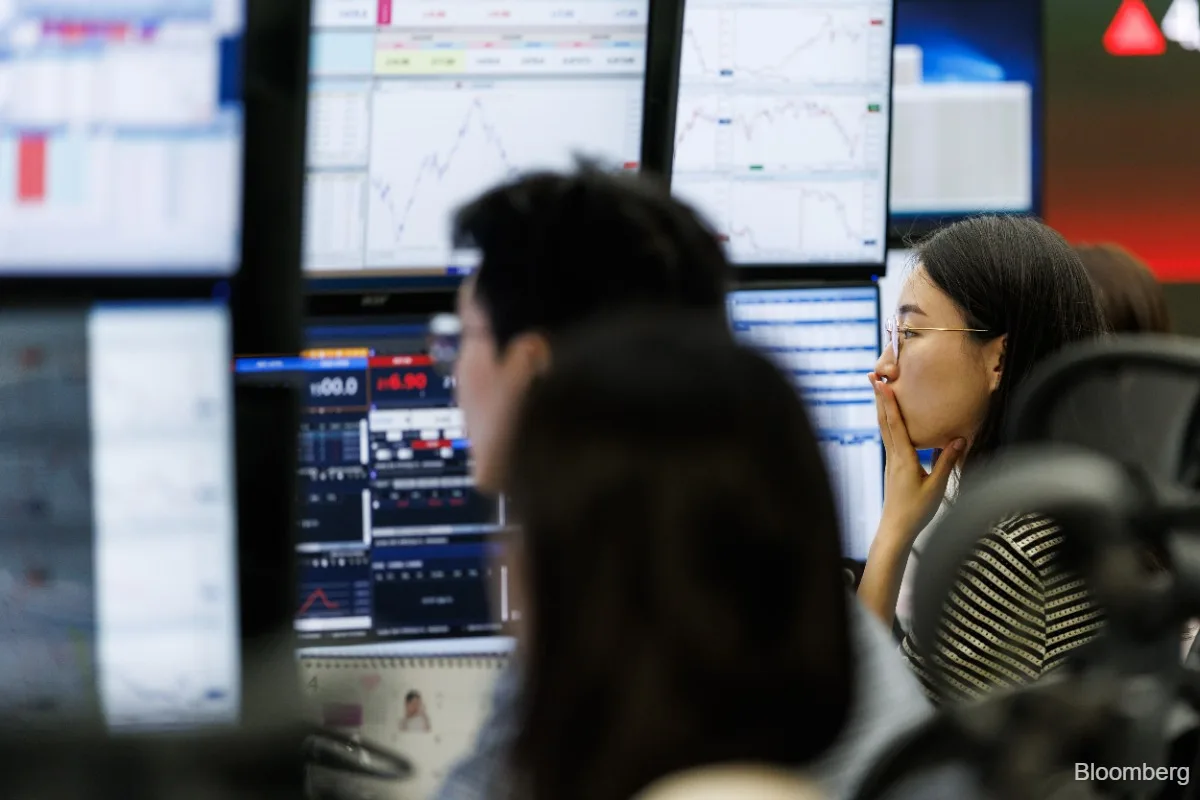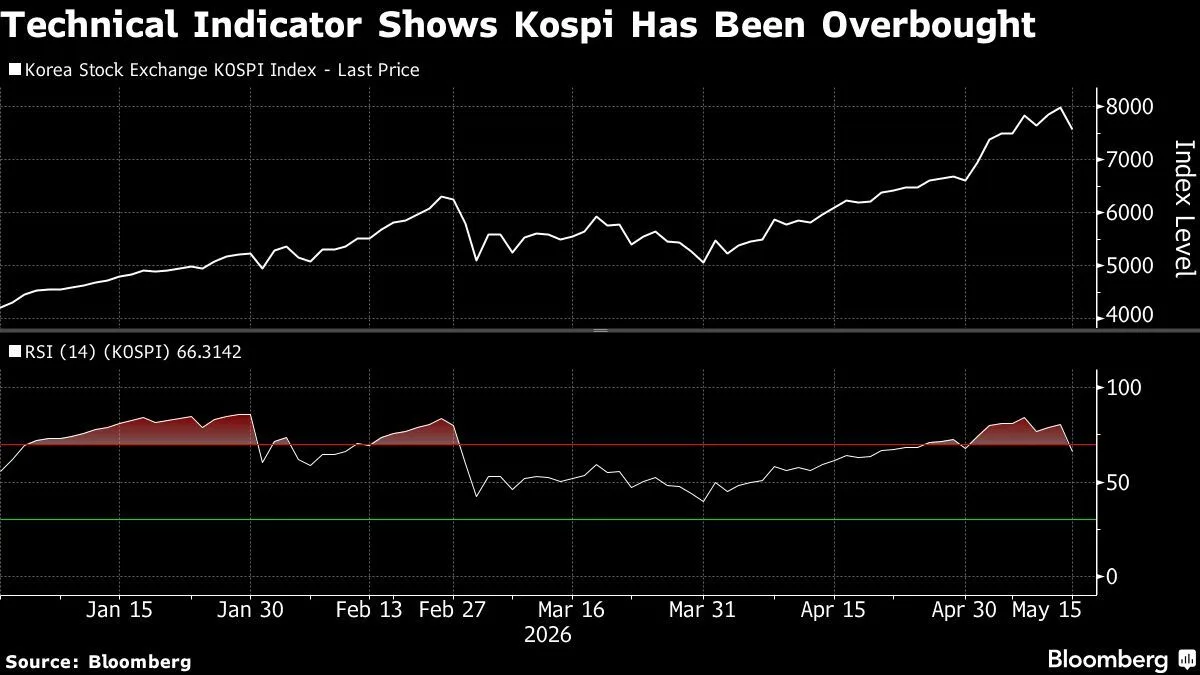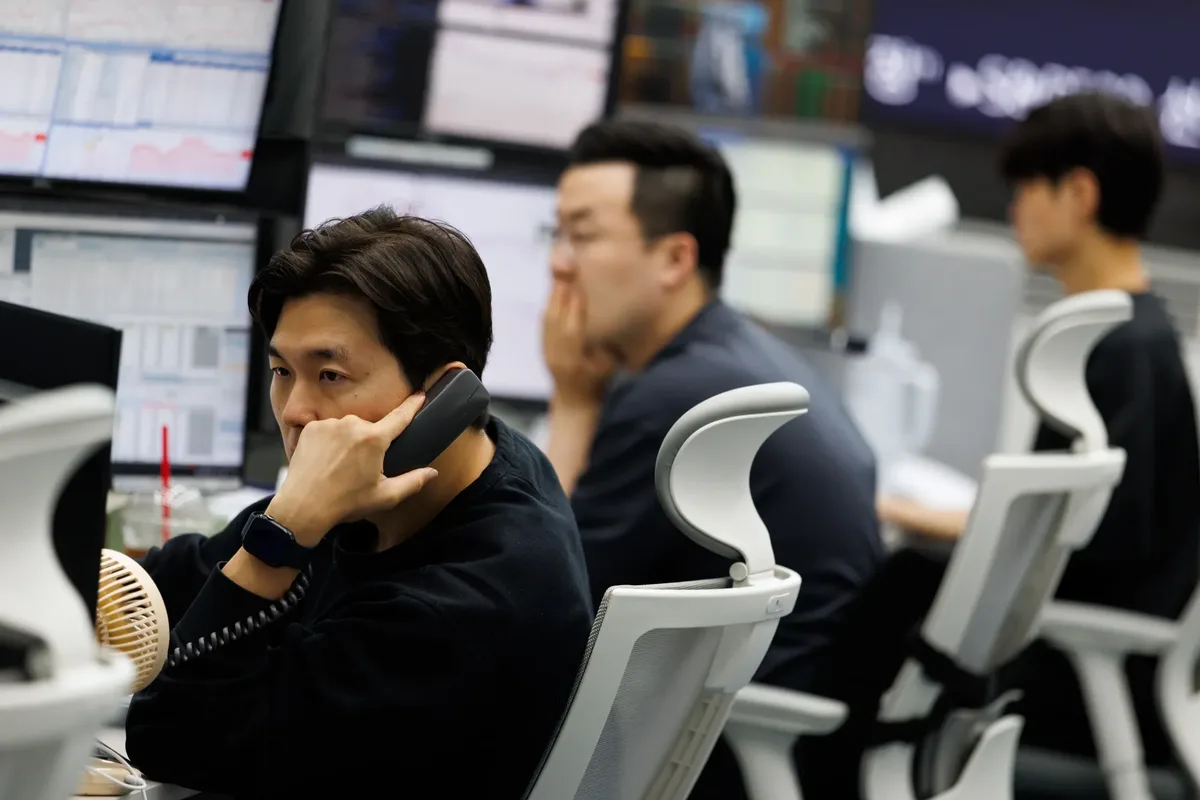
Foreign investors have sold around $11.5 billion of Korean stocks on a net basis so far in May 2026, marking the third-largest monthly withdrawal on record after February and March [1, 2].
On May 15, the Kospi Index briefly hit the 8,000 mark before plunging nearly 7%, its largest intra-day drop since March 9, as selling intensified [3, 4]. The Korea Exchange halted Kospi program trading after futures slumped more than 5% amid the turmoil [3, 4].
The selloff was focused heavily on technology shares. Foreign investors withdrew over $2.8 billion from the Kospi tech subsector alone [3]. Samsung Electronics shares plunged about 8.6%, while SK Hynix declined roughly 7.7-8%, both posting their worst daily declines since early March [3, 4]. Roy Lim of NH Investment & Securities said, "The strike issue appears to be stoking selloffs on Samsung," referring to an ongoing prolonged labor strike at Samsung that has unsettled investors [3]. Labor negotiations are expected to resume only after June 7 [3].
Despite the sharp drop, the Kospi rally this year has been largely driven by Samsung Electronics and SK Hynix, which together make up about two-thirds of the index's near-90% gains in 2026[ s2,s4]. Christian Heck of First Eagle Investments noted, "The more important point is that the Kospi has become, to a large extent, a bet on two large memory semiconductor companies comprising about half of the index weighting." Retail investors have increased borrowing to amplify stock bets, contributing to daily swings of 5% or more becoming common [3].
Korean equities were the worst performers in Asia on May 15, pressured by uncertainty over Iran peace talks and a US-China summit that failed to produce meaningful outcomes [3, 4]. Negative market sentiment was further fueled by former US President Donald Trump's comment that the US does not need the Strait of Hormuz to open [3, 4].
Foreign investors sold 5.6 trillion won ($4.9 billion) in Kospi shares on May 15 alone, adding to a weekly net outflow of 14.3 trillion won [4]. Jun Gyun of Samsung Securities described the pullback as "exhaustion after a rally that came too fast, too hard – not a story of deteriorating earnings or a bubble bursting. It’s too early to call it that" [4].
The Kospi index remains expensive compared to its historical levels within Korea despite cheaper valuations relative to US benchmarks [3]. Ha SeokKeun of Eugene Asset Management added, "There may be more legs in Samsung’s rally but there seem to be more investors who decided to partly lock in their profits for now." [3]
Labor talks at Samsung are expected to resume after June 7, with investors closely watching developments amid strike concerns [3].