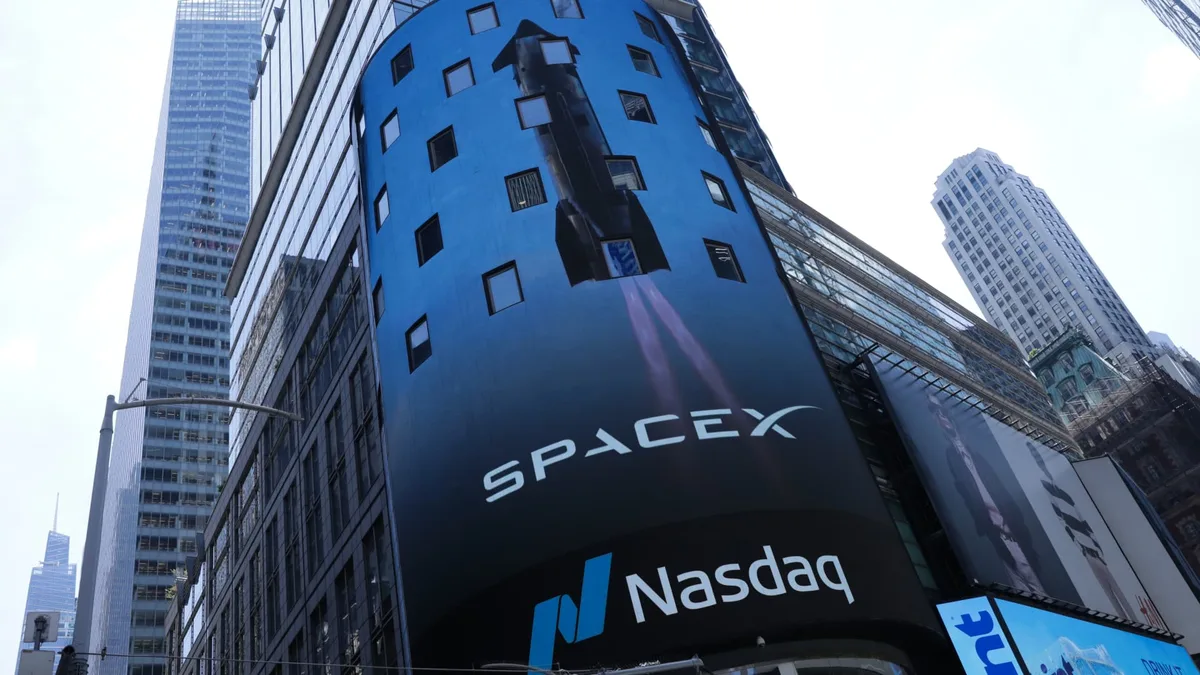
SpaceX held its initial public offering on June 12, 2026, with shares opening on the Nasdaq and closing at $160.95, up 19.22% from the IPO price after an intraday gain near 30% [1, 2]. The IPO valued SpaceX at about $1.8 trillion, making it the seventh largest U.S. company by market value at a per-share price of $135 [3, 4, 5].
Retail investors were allocated 20% of the IPO shares but face resale restrictions ranging from 15 to 30 days imposed by brokers such as Fidelity, Robinhood, E*TRADE, and SoFi [1]. Violating these limits could trigger penalties including bans from future IPO participation or permanent trading bans on these platforms [1]. Institutional and long-term investors, including hedge funds and asset managers like BlackRock and Citadel, received 10% and 70% of shares respectively, with fewer or no resale restrictions [1].
Following the IPO, active mutual funds and ETFs such as Fidelity’s parent FMR, Baron Capital Group, Franklin Resources, BlackRock, and Neuberger Berman have included SpaceX shares in their portfolios [2]. Some funds hold SpaceX as more than 10% of their net assets, with Baron funds having up to 20% exposure [2]. Jaime Magyera, Head of BlackRock's Retirement and U.S. Wealth Advisory businesses, said, "From a 401(k) plan perspective, I would say it's not an immediate opportunity. But, for some people, the stock will gradually make its way into index funds that are likely in their 401(k) plans" [2].
SpaceX’s stock will begin appearing in passive index funds after meeting index inclusion criteria. It will join the Russell 1000 Index after five trading days of public trading, on June 17, and the Nasdaq-100 Index after 15 trading days, on July 6 [3, 4, 5, 2]. However, SpaceX is unlikely to enter the S&P 500 index for several years since it must be publicly listed for at least 12 months and show recent profitability [3, 4, 5].
Investors seeking SpaceX exposure can buy shares directly via the IPO or through active and passive funds holding it. Direct IPO share ownership generally entails higher price volatility than diversified funds, while active funds often charge higher fees compared to index funds [3, 4, 5].