The US economy added 57,000 jobs in June, well below economists' estimates of around 110,000, according to the June jobs report released July 2, 2026 [1, 2, 3, 4, 5, 6]. The unemployment rate fell slightly to 4.2%, under the expected 4.3% [1, 2, 3, 4, 5, 6]. Nonfarm payroll gains for May and April were also revised downward [1, 7].
The softer-than-expected employment figures led investors to reduce expectations for Federal Reserve interest rate hikes in the coming months. The probability of a rate increase at the Fed's September meeting dropped from around 64% to 55%, per CME FedWatch data [2, 3, 5]. Short-term US interest rate futures suggested about a 60% chance of a hike, down from 75% before the data [7]. "It just takes the pressure off the Fed to raise rates in the short term," said Adam Sarhan, CEO of 50 Park Investments [2].
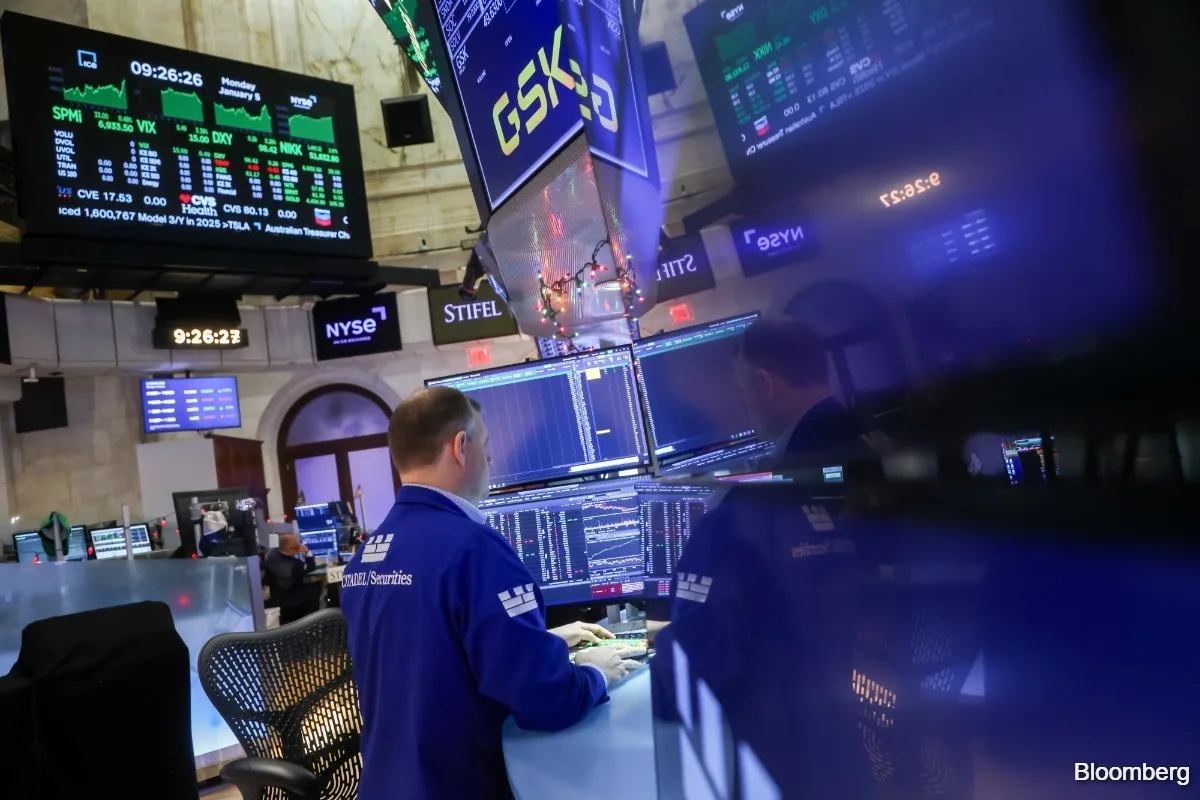
Market reactions reflected the data. At the open on July 2, the Dow Jones Industrial Average rose about 90 points (0.17%) to roughly 52,395 [8, 9, 6]. By the close, it had surged 594.83 points (1.14%) to a record 52,900.07, marking its longest winning streak of four weeks since October 2024 [2, 3, 5]. The S&P 500 ended mostly flat or marginally up near 7,483 [2, 3, 5], while the Nasdaq Composite declined sharply, down about 207 points (0.8%) to 25,832.67 due to a selloff in semiconductor stocks [2, 3, 4, 5]. Nvidia and SanDisk shares fell 1.4% and 14.1%, respectively, on profit-taking after strong gains earlier this year [2, 3, 4, 5]. Bruce Zaro of Granite Wealth Management noted investors were "likely taking profits in chip stocks following this year's strong gains" [2].
Meanwhile, Apple shares rose 4.8% on reports of plans to launch five new iPhone models, buoying major indexes [2, 3, 5]. Tesla shares dropped 7.5% despite beating second-quarter 2026 delivery estimates [5].
Economists and strategists said the labor market remains expanding but less overheated. Andrew Dubinsky, UBS's Chief Investment Office head, said, "A labor market that is still expanding, but no longer overheating, allows the Fed to remain patient while assessing price pressures" [1]. Brian Jacobsen of Annex Wealth Management said moderating inflation expectations mean "the Fed can take the whole summer off if it wants as it won’t have to hike or cut" [1]. Bret Kenwell of eToro added, "Just when investors thought they had the labor market figured out, the June jobs report threw them a curveball" [1].
Concerns about inflation persist due to rising oil prices linked to the Iran war [2, 3, 5]. Lindsay James, a strategist at Quilter, said with easing price pressures and ongoing policy uncertainty, "there is a possibility that those hikes may not materialise" [7].
US stock markets were closed July 3, 2026, for the Independence Day holiday [2, 3, 5].