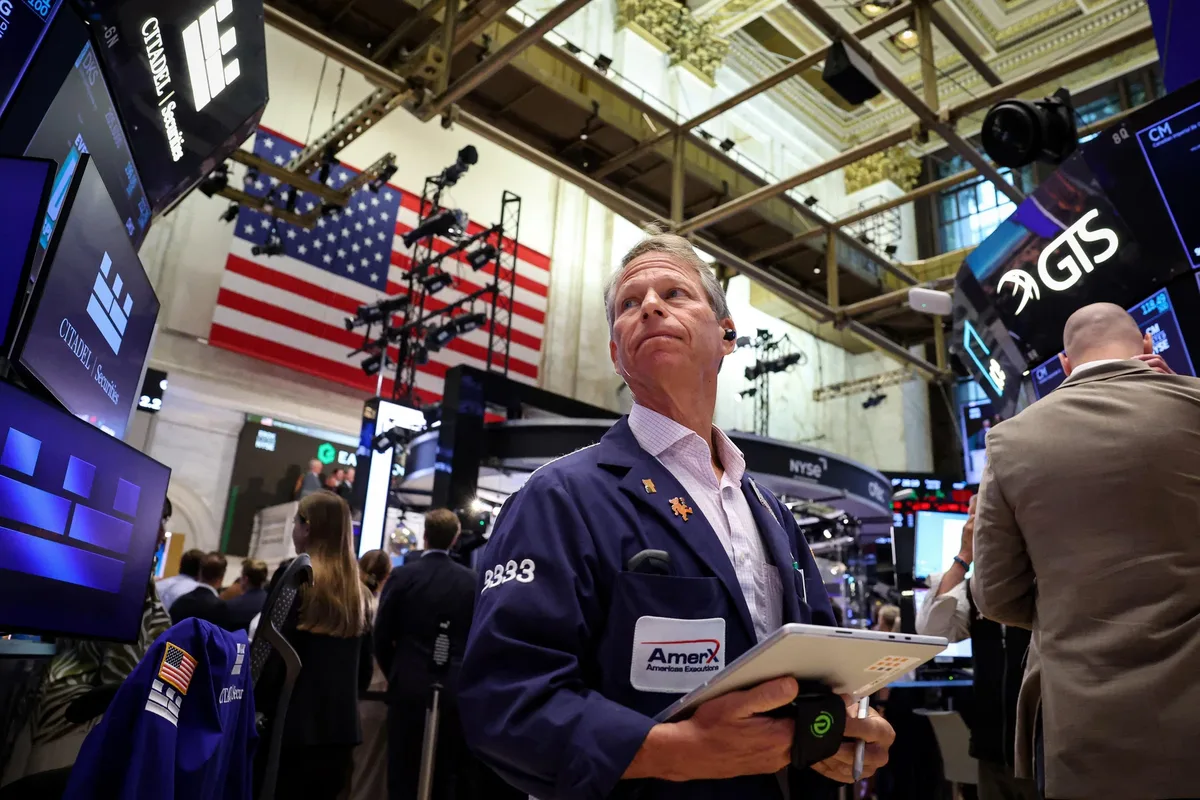
On July 27, US stock markets closed mixed with the Nasdaq falling 0.22%, the Dow Jones rising about 0.5% to 1%, and the S&P 500 ending slightly up to flat amid investor caution ahead of major technology earnings reports scheduled this week from Microsoft, Amazon, Meta, and Apple [1, 2, 3]. Bill Merz from US Bank Asset Management said, "Today represents a continuation of the rotational market that we’ve seen. Part of the market reaction may be related to that creeping suspicion that perhaps a rate hike is coming" [2].
Concerns over high capital expenditures on artificial intelligence drove declines in chip stocks, with the PHLX semiconductor index dropping around 4.5% on July 28 and down roughly 21-25% from its June 22 record high [1, 2, 4]. Ross Mayfield of Baird noted the market's shift away from tech, stating, "What has been behind the move into these non-tech names? Part of it is value. GDP is solid, the labor market continues to churn along and, in a lot of places, there’s evidence that consumer spending is reaccelerating" [4].
On July 28, the S&P 500 closed modestly higher at 7,428.78 points (+0.21%) helped by gains in Boeing and Coca-Cola which offset declines in semiconductor shares. The Dow Jones gained over 1% while the Nasdaq slipped about 0.22% [1, 4, 5]. Brent crude oil prices retreated to about $89 per barrel following earlier surges linked to Middle East tensions and US-Iran negotiations [2].
In Singapore, the Straits Times Index edged down 0.07% (4.13 points) to 5,616.11 on July 28 amid mixed global sentiment. Corporate earnings announced included CapitaLand India Trust, Keppel REIT, Singapore Airlines, DFI Retail Group, and Hongkong Land, reporting mixed first-half 2026 results [1].
China’s CXMT Corp made a strong debut on July 27, while a Chinese state-backed company began mass production of deep ultraviolet lithography machines, escalating competition in semiconductor manufacturing [1, 2].
Market participants now focus on the upcoming Federal Reserve rate decision due July 29. The market prices in a 71% chance of no change and a 29% chance of a 25 basis point hike [4].