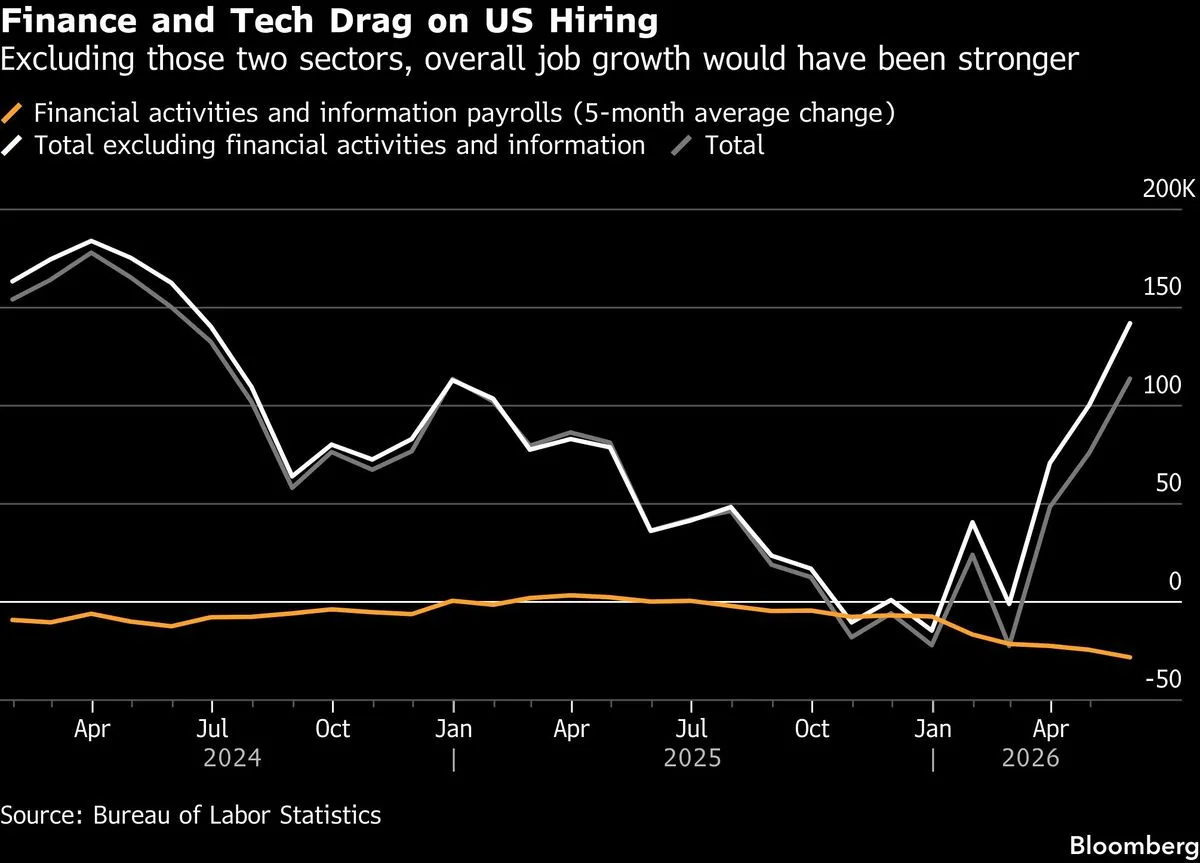
U.S. financial activities and information sectors experienced an average monthly decline of 28,000 jobs in the first half of 2026 amid rapid adoption of artificial intelligence technologies [1, 2]. Over 102,000 job cuts nationwide this year have been officially attributed to AI, according to data from Challenger, Gray & Christmas [1, 2].
The tech sector accounted for about one-third of all layoffs announced in the U.S. in 2026 [1, 2]. John Challenger, CEO at Challenger, Gray & Christmas, said, "It’s certainly making an impact as we speak in a way that no technology has before" and predicted finance "might be the next big sector that’s most affected." Many finance jobs are vulnerable to AI-driven reductions because about 25% involve office and administrative support roles, which are more easily automated [1, 2]. The California Policy Lab data shows high unemployment benefit claims among workers in AI-exposed financial and insurance jobs [2].
However, some economists caution that layoffs partly reflect cost-cutting following heavy AI investments rather than direct productivity-driven job destruction [2]. The Yale Budget Lab states data reveals no unusual spikes in finance layoffs, suggesting impacts may be more via hiring freezes and attrition than mass layoffs [2].
Contrasting these findings, research published by Business Insider in June 2026 found companies investing heavily in AI generally increased total headcount by 10.2% and entry-level hiring by 12% over two years after adoption [3]. The authors of the Ramp and Revelio Labs study warned, "If you are reading headlines where CEOs blame layoffs on AI, be skeptical." Nvidia CEO Jensen Huang called CEOs linking layoffs to AI "lazy" and "scaring people." OpenAI CEO Sam Altman said in May 2026, "I do not think there will be the kind of jobs apocalypse that some of the companies in our space advocate or talk about" [3].
Stanford’s Digital Economy Lab found AI weakens employment where automation replaces tasks but supports jobs where AI aids workers [1, 2]. This suggests the employment impact of AI varies significantly across job types.
The debate over AI’s real impact continues. While some data shows clear job cuts linked to AI, other evidence points to offsets from expanded hiring at high AI adopters and gradual shifts rather than sudden mass layoffs. Analysts continue to monitor payroll and unemployment trends for clearer signals.
The next major data point will be the jobs report for the second half of 2026, expected in early 2027, which should clarify if the trends accelerate or stabilize.