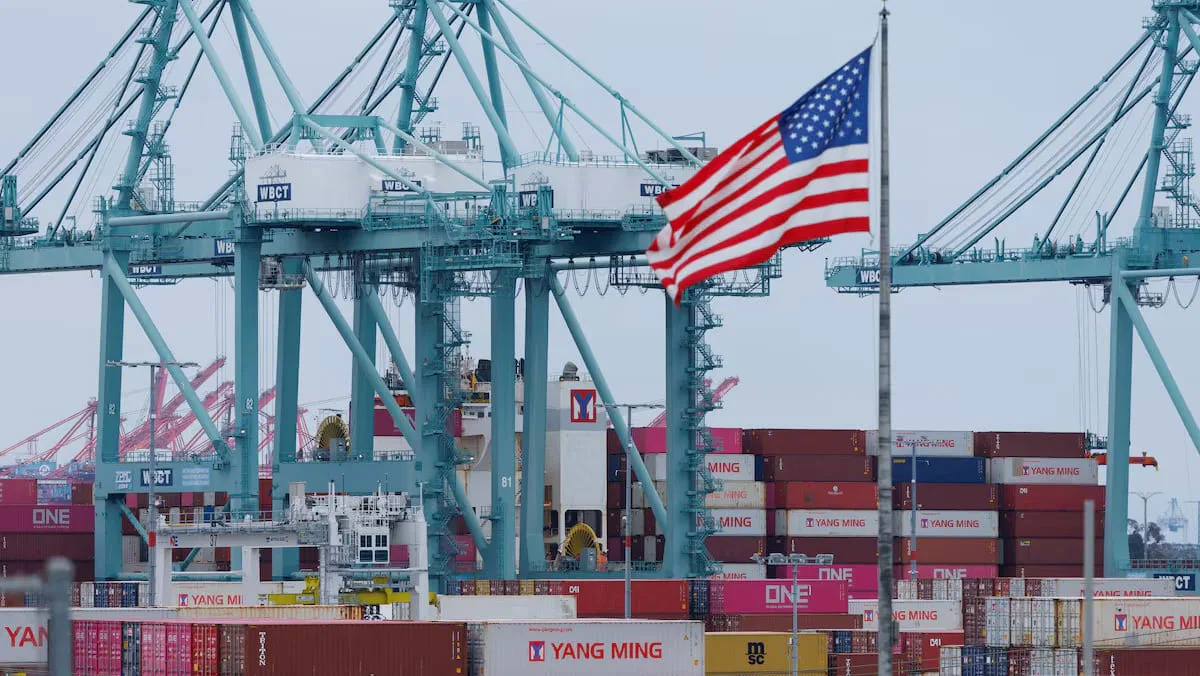
The US goods and services trade deficit decreased to $55.9 billion in April 2026, down 1.2% from a revised $56.6 billion in March, according to data released by the US Commerce Department on June 9 [1, 2]. Economist Mucahithan Avcioglu noted, "The trade gap decreased by $0.7 billion to $55.9 billion in April, from a revised $56.6 billion in March. The markets had expected the deficit to come in at $56.2 billion in April" [1].
US exports hit a record $327.1 billion in April, rising 2.6% compared to March, led by a surge in crude oil and petroleum product exports [3, 4, 5, 1, 6, 2, 7]. Oil exports reached a historic high of $36.7 billion, about 60% higher than March, boosted by elevated global prices amid US-Iran tensions and constrained supply through the Strait of Hormuz [4, 5, 6, 2, 7]. These export gains significantly contributed to narrowing the trade deficit.
US imports rose approximately 2.0% to about $383 billion, driven largely by strong demand for capital goods related to AI infrastructure, including computers, semiconductors, and telecommunications equipment [3, 4, 5, 1, 6, 2, 7]. Despite higher imports, the goods trade deficit narrowed by $2.4 billion to $83.7 billion while the services trade surplus declined to $27.8 billion [5, 1]. Services exports slightly fell, weighed down by weaker tourism and transport sectors, with tourism exports hitting a two-year low in April [6, 2].
Trade flows with key partners showed mixed trends. The US trade deficit with China expanded to about $10.39 billion according to some sources, while others reported it narrowed by $2.6 billion to $12 billion, reflecting conflicting data [4, 2]. The deficit with Mexico narrowed due to record US exports, whereas the deficit with Canada expanded [6]. Canada recorded a trade surplus of 2.72 billion Canadian dollars in April, supported by rising crude oil prices and a 7% jump in oil exports [8].
Year-to-date through April 2026, the US goods and services trade deficit shrank by 49.1% compared with the same period in 2025. Exports were up 11.3% year-over-year, while imports fell 5.5% [1, 7]. Analysts estimate that adjusting for inflation and excluding oil and AI-related goods, the underlying US trade deficit in April was near $230 billion, indicating structural improvements influenced by tariffs and supply chain shifts [7]. These tariff policies, implemented under the Trump administration, helped reduce consumption goods imports by 15.6% year-over-year [7].
The narrowing deficit and record exports arrive amid ongoing geopolitical tensions and strategic tariff measures reshaping US and global trade flows [1, 6, 2, 7]. Next data on US trade is expected with May 2026 results, which will further clarify trends in the post-tension and AI investment environment.