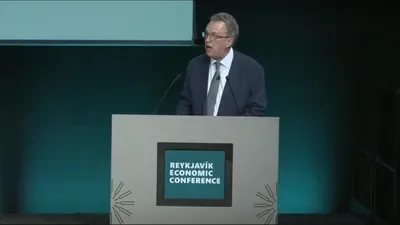
Federal Reserve Bank of St. Louis President Alberto Musalem cautioned policymakers on May 28 in Reykjavík, Iceland, against relying on an AI-driven productivity boom to ease the US’s elevated inflation. [1, 2, 3, 4]
Musalem said, "I believe it would be risky to rely on the prospect of higher productivity growth in the future to solve our inflation problem today," underscoring the uncertainty of near-term productivity gains from AI. [2] He noted the probability of the US currently being in a period of high productivity growth is meaningfully below 50%. [3]
Rising inflationary pressures have been renewed by the recent escalation in US-Iran military tensions near the Strait of Hormuz around May 27-28, which pushed international oil prices up about 3%, further complicating the outlook. [4] Several Fed officials have warned that interest rates may need to rise if elevated inflation persists.
The Fed’s preferred inflation measure, the personal consumption expenditures price index, rose 3.8% over the 12 months ending April 2026, well above the Fed’s 2% target. [2, 3, 4] Long-run inflation expectations are also drifting higher. [2, 3, 4] Musalem highlighted that after adjusting for inflation, the Fed’s benchmark interest rate remains below the neutral level that neither slows nor stimulates the economy. [2, 3, 4]
While Musalem expressed skepticism about AI's near-term inflation relief, he remains optimistic about its economic potential and personally uses AI tools. [2, 3, 4] However, he noted rising AI demand increases electricity and chip usage, contributing to higher costs and some AI company stock price gains. [2, 3, 4]
Musalem warned that prematurely lowering rates could undermine confidence in the Fed’s inflation target, increase long-term interest rates, and harm investment, growth, and employment. [4] Fed officials including Lisa Cook and Austan Goolsbee have voiced concerns that AI investments and growth expectations might actually drive inflation higher. [4]
Fed New York President John Williams said US inflation remains elevated in the short term but long-term expectations are stable. He said current policy is appropriate but higher rates may be needed if inflation stays high. [4] Investors price in more than a 50% chance of a rate hike by the end of 2026. [2, 3]
The Fed’s next policy meeting is scheduled for June 17-18, 2026, and will be the first under new Chair Kevin Warsh. [2, 3] Warsh has suggested AI could unleash a productivity boom enabling non-inflationary growth and potentially lower interest rates, a view Musalem challenged. [2, 3, 4]