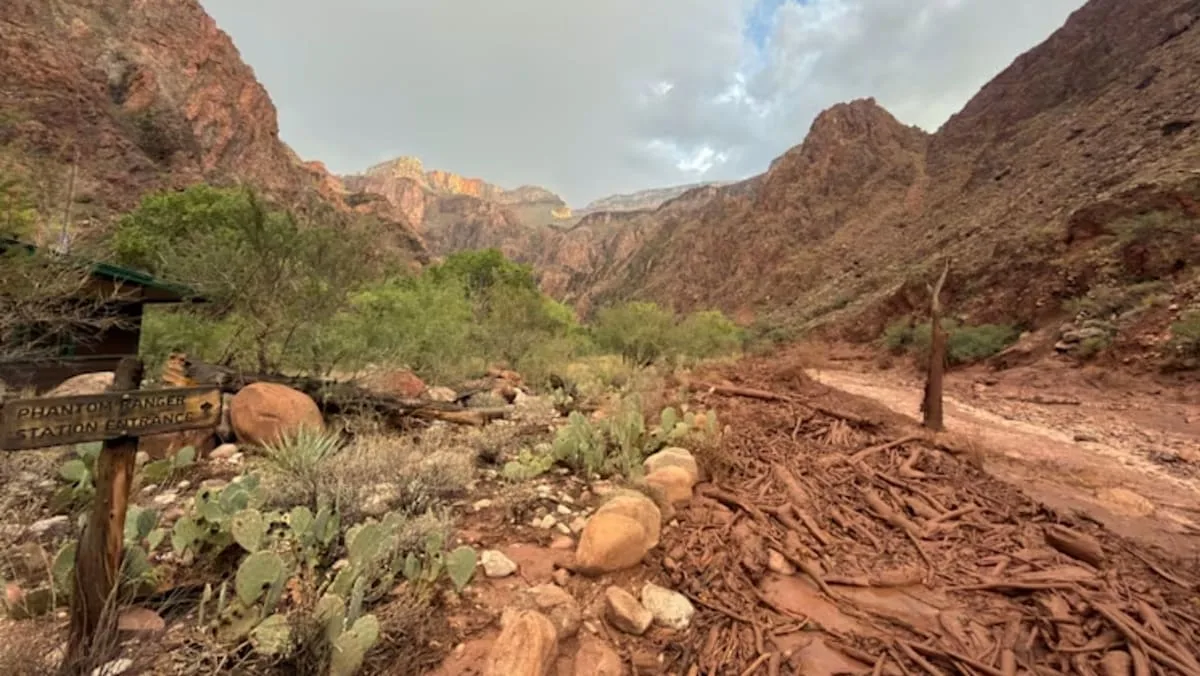
A severe flash flood struck Bright Angel Creek in Grand Canyon National Park, Arizona, on August 29, 2026, causing extensive damage and forcing large-scale evacuations [1, 2, 3, 4, 5, 6]. The flood destroyed pedestrian bridges, widened the creek bed, and swept large boulders, metal structures, and debris into the Colorado River, damaging infrastructure and recreational facilities [1, 2, 3, 4, 5, 6].
At least 60 to 62 hikers and campers from areas including Bright Angel Campground, Phantom Ranch, and North Kaibab Trail were evacuated by helicopter and ground teams over August 29–30, with about 50 people specifically airlifted from Bright Angel Campground [1, 7, 3, 8, 4, 5, 6]. Eyewitness Erica Viola described watching the creek’s water level rapidly rise, accompanied by debris flows that included what looked like construction structures, before her group was rescued [3].
Authorities report that more than 20 people remain missing or unaccounted for following the flood, though some sources cite approximately 15 as missing. Search and rescue operations are ongoing, led by the National Park Service in cooperation with the Arizona Department of Public Safety on August 30 and 31 [1, 2, 7, 3, 8, 4, 5, 6]. No fatalities or injuries have been officially confirmed so far [7, 8, 5].
Meteorologists attribute the flash flood to steep terrain causing rapid runoff. Rainfall of 10 to 25 millimeters (half to one inch) fell in about 30 minutes, with most water running off quickly to create sudden flooding [1, 2, 3, 4]. Justin Johndrow, meteorologist at the National Weather Service Flagstaff, said, “大多數雨水瞬間流失” (most rainwater runs off instantly) [1].
The flood prompted closure of popular park areas such as Phantom Ranch, Bright Angel Campground, North Kaibab Trail, and segments of the Colorado River [8, 5, 6]. Jack Schmidt, director of the Center for Colorado River Studies, said the event “再次提醒我們,大峽谷(Grand Canyon)的地貌多麼變化莫測而且活躍” (reminds us how unpredictable and active the Grand Canyon’s geography is) [1].
Further storms and heavy rains are forecast for the region, raising the risk of additional flash floods, mudslides, rockfalls, and changes to roads and trails [7, 8, 5]. Authorities have warned visitors to remain cautious and continue evacuations and search operations through August 31 [1, 2, 7, 3, 8, 4, 5, 6].
The Grand Canyon National Park saw over 4.43 million visitors in 2025, making it one of the most visited parks in the United States [8].