A global poll by Pew Research Center conducted from February 8 to May 13, 2026, surveyed 42,151 adults across 36 countries on their views of President Donald Trump and the US international role [1, 2, 3, 4, 5]. Only 23% of respondents expressed confidence in Trump to handle world affairs, while 76% said they had little or no confidence in his global leadership [3, 4, 6, 5].
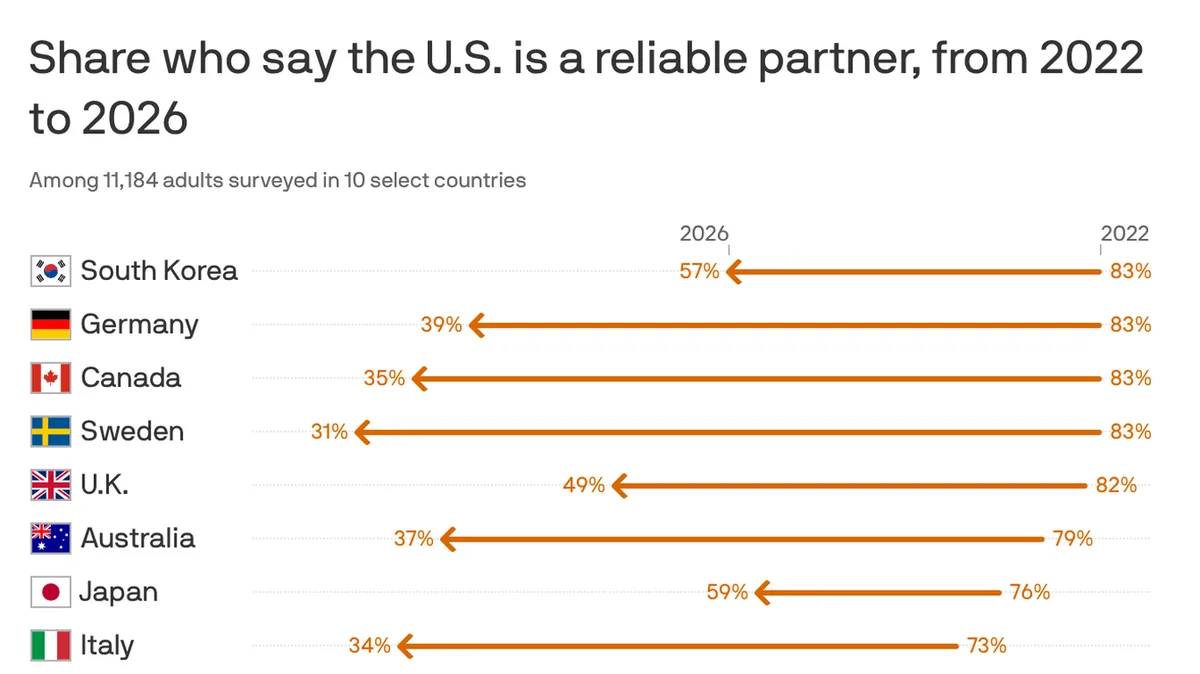
The survey found US favorability stands at about 37%, with 57% holding an unfavorable opinion of the country internationally [1, 2, 3, 4, 7, 6, 5]. Half of all respondents called the US an unreliable partner, compared to 47% who consider it reliable [3, 7, 6, 5]. Only 32% believe the US takes other nations’ interests into account in developing foreign policy, and two-thirds disagree [3, 6, 5].
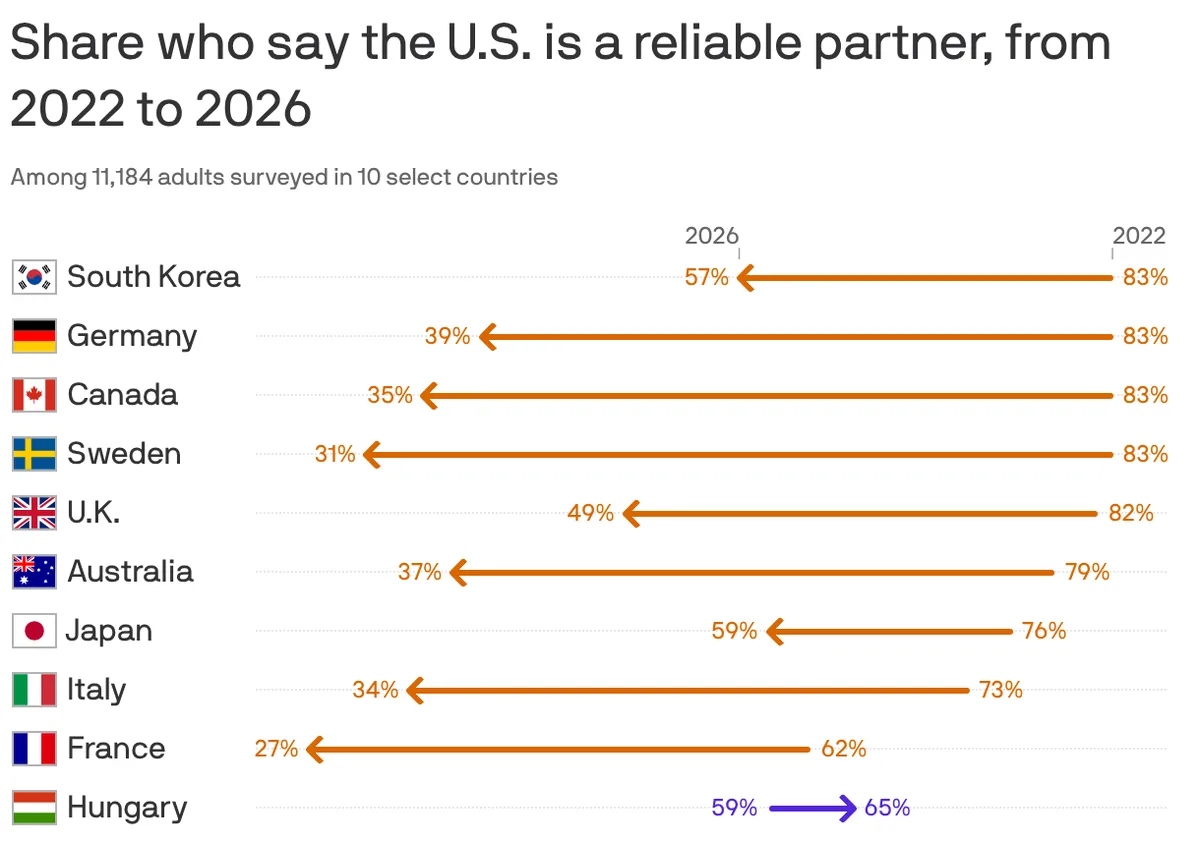
Compared to 2022, trust and favorable views of the US dropped in 15 to 16 countries following the Biden administration, notably Canada, Sweden, the Netherlands, Germany, France, Spain, Italy, the UK, Japan, Indonesia, Nigeria, South Africa, South Korea, and Turkey [1, 2, 3, 4, 6, 5]. Canada’s perception of the US as a reliable partner plunged from 83% in 2022 to 35% in 2026, Sweden’s trust dropped 52 percentage points, and the Netherlands and Germany both fell more than 40 points [3, 4, 6, 5]. Japan’s reliability rating fell from 76% to 59%, while France, Spain, Italy, and the UK saw drops above 30 percentage points [3, 4, 6].
Hungary stood out as an exception with a rise in US reliability ratings from 59% in 2022 to 65% in 2026, likely linked to Viktor Orbán’s alignment with Trump before Orbán stepped down after April elections [3, 4, 6].
No majority in any surveyed country supported Trump’s handling of major international issues such as Iran, Gaza, Ukraine conflicts, immigration, tariffs, or humanitarian aid [3, 4]. During the survey, US and Israeli attacks on Iran triggered global condemnation and economic disruptions [3, 4].
Only 35% of respondents believe the US contributes to world peace and stability, and 56% feel the US government does not respect individual freedoms domestically [2, 5]. Trump’s international approval ratings ranged widely, from a low of 4% in the West Bank and East Jerusalem to a high of 68% in the Philippines [7]. His ratings in the UK, Spain, Germany, and France were slightly higher than at the end of his first term but remain far below those of Barack Obama and Joe Biden [7]. He trails behind many world leaders in median global confidence, including Russia’s Vladimir Putin (31%), China’s Xi Jinping (34%), Ukraine’s Volodymyr Zelenskyy (35%) and France’s Emmanuel Macron (43%), but stays ahead of Israeli Prime Minister Benjamin Netanyahu (18%) [7]. His US national approval stands near 39%, similar to Biden’s and his own first term levels [7].
"After Trump's inauguration last year, we saw significant shifts; this year's data shows those shifts intensifying in most countries' views of the US," said Richard Wike of Pew Research Center [3].
Pew Research Center released the full results of the poll on June 23, 2026, providing the most detailed recent snapshot of global attitudes toward Trump and the US [1, 3, 4, 7, 6, 5].