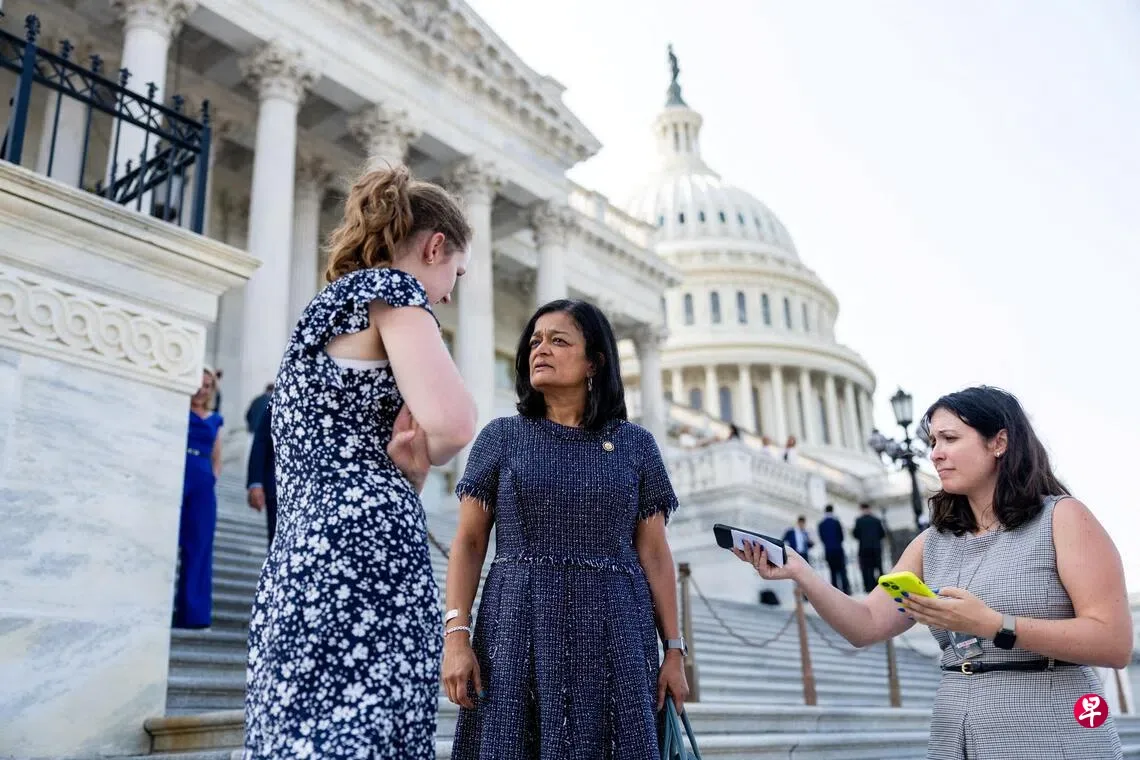
The US House of Representatives passed a symbolic war powers resolution on July 23, 2026, directing President Donald Trump to stop military action against Iran unless Congress authorizes it. The measure passed by a narrow 214-208 vote, with four Republicans joining Democrats in support: Tom Barrett, Brian Fitzpatrick, Warren Davidson, and Thomas Massie [1] [2] [3].
The resolution was introduced by Democratic Representative Pramila Jayapal of Washington and instructs the president "to remove the use of United States Armed Forces from hostilities" against Iran without Congressional approval. Jayapal said, "This is a vote that requires us to find the strength to do what is right for the American people, and to send the clearest, even stronger message to this president... that the United States Congress... is reasserting our authority over war. This war must end." [1] [2] [4]
The House measure is largely symbolic and non-binding. Similar resolutions have passed in recent months without stopping hostilities between the US and Iran [1] [3] [5]. The conflict escalated after US and Israeli airstrikes in late February 2026 and deteriorated further when a ceasefire collapsed in early July 2026. Iranian attacks killed three US service members in mid-July. President Trump increased military actions following these attacks [6] [4].
The escalating conflict has included Houthi militants striking Saudi oil tankers in the Red Sea and US airstrikes on Iran, which triggered Iranian retaliatory fire on US bases nearby. The war has resulted in at least four US military deaths recently. It has also driven Brent crude oil prices above $100 per barrel and US gasoline prices to $4.09 per gallon [1] [2] [7] [6].
Later on July 23, the US Senate voted 49-47 to block a similar war powers resolution designed to rein in Trump's war powers on Iran. Senator Susan Collins joined Democrats to support the Senate resolution. Senator John Fetterman voted with Republicans against it. Senator Chris Van Hollen said, "There is no good way out of a bad war. This is an opportunity for this Congress to finally take responsibility." Opposing the measure, Senator John Kennedy warned that forcing a withdrawal mid-conflict would harm American credibility and distract from other priorities [3] [7] [8] [9].
The White House defended the president's actions, stating, "The president has constitutional authority to protect the United States and its citizens from the threat posed by the Iranian regime. This requires the president to be able to act decisively to make sure Iran never obtains a nuclear weapon." President Trump said "major military punishment" would be delivered to Iran and its Houthi allies after attacks on Saudi oil tankers [1] [8].
Congressional frustration over the extended conflict and its costs has grown bipartisan support for war powers oversight measures. Both chambers took opposing positions on July 23 amid debates on the scope of executive authority in the ongoing war.
The House resolution remains non-binding, with no timeline for further action scheduled soon [1] [3].