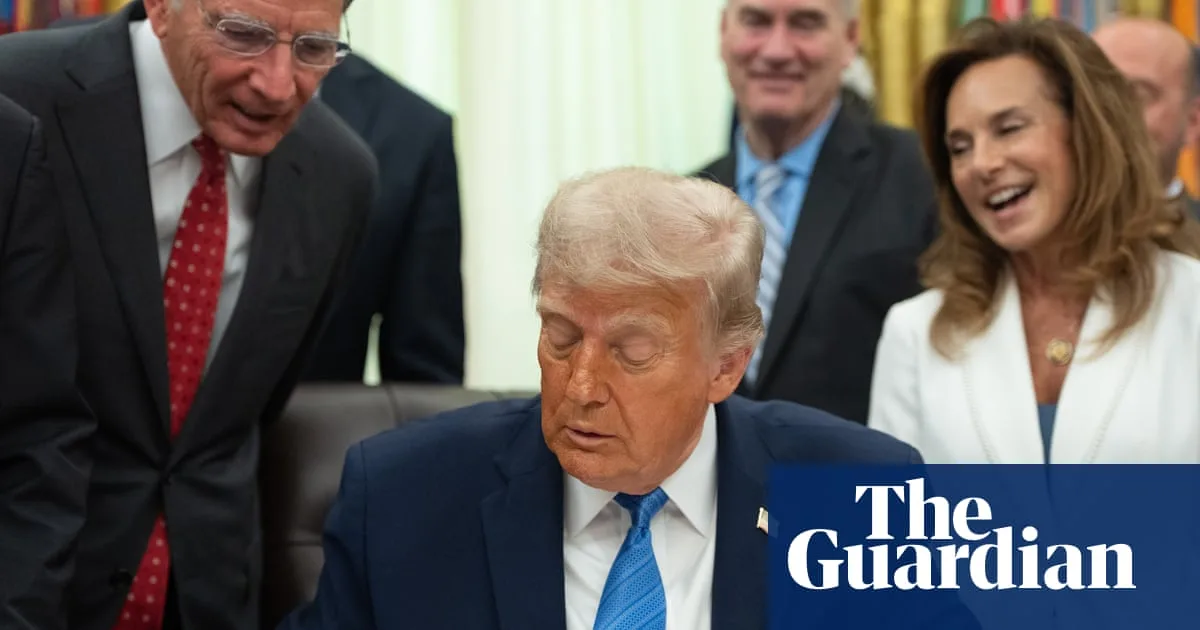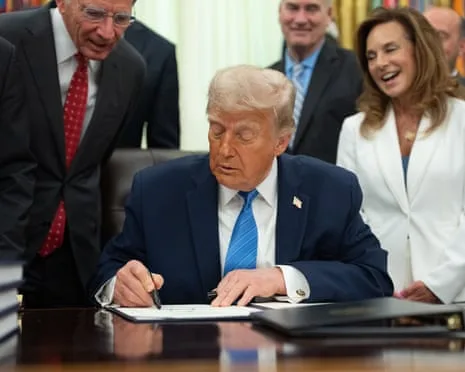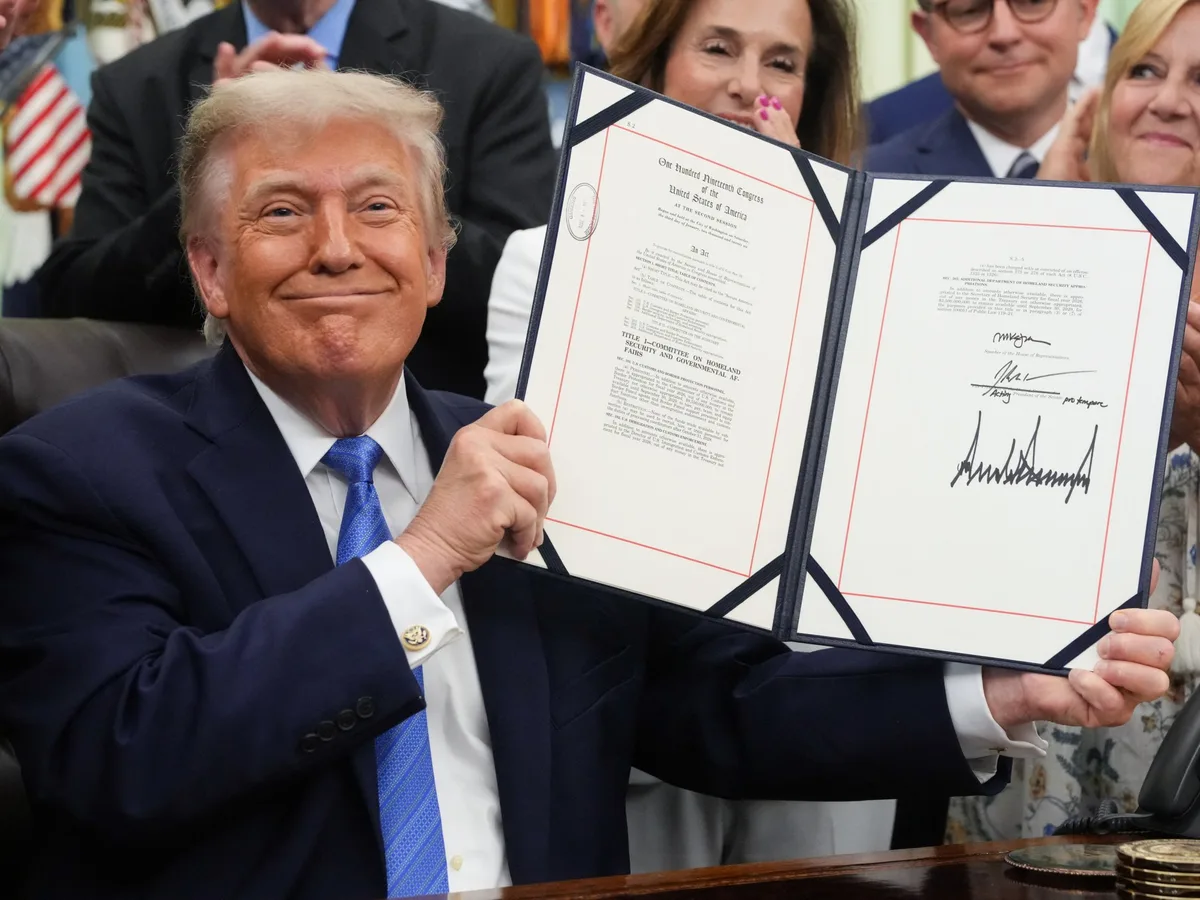
The US Congress approved a $70 billion budget bill to fund immigration enforcement agencies through the end of President Donald Trump's term, with Trump signing the bill into law on June 10, 2026, during a ceremony in the Oval Office [1, 2, 3, 4].
The Secure America Act allocates about $38 billion to Immigration and Customs Enforcement (ICE), $26 billion to Customs and Border Protection (CBP)/Border Patrol, and $5 billion for contingency or unforeseen expenses [1, 5, 2]. Funding extends through fiscal year 2029 [1, 5, 2].
The Senate passed the bill on June 5 with a 52-47 vote, receiving no Democratic support and using budget reconciliation to bypass a filibuster [5, 6, 7, 8]. The House narrowly approved it the next day, June 9, by a 214-212 vote mostly along party lines, with Democrats opposing [5, 2, 9, 8, 10]. House Speaker Mike Johnson said, "With today's vote, House and Senate Republicans have officially ended the third Democrat government shutdown of this Congress" [8].
Democrats condemned the bill as a "blank check" to ICE and CBP without oversight. House Minority Leader Hakeem Jeffries said Republicans were giving "Donald Trump’s violent mass deportation machine another $70bn blank check, with no oversight, no accountability and no guardrails" [1, 2]. Pete Aguilar, House Democratic Caucus Chair, called it a "$70 billion blank check for ICE and border patrol, with no strings attached" [7]. Jeffries also criticized Republicans for cutting other social programs while funding enforcement agencies at this level [9].
Republicans emphasized border security as a key issue. Lindsey Graham, Senate Budget Panel Chair, said, "In less than two years, President Trump has taken the border from the most broken to the most secure in history. The bill we passed today locks those gains in through the rest of his term." Rep. Johnson added in Mandarin that border security funding was long overdue and regrettably accomplished by Republicans alone [6, 9]. Trump called ICE and border patrol "heroes" who deserved "the support and resources they need to defend our borders, protect our homeland, and to keep America safe" [2].
The bill ends months of partisan conflict and funding standoffs triggered in January 2026 by a federal immigration enforcement operation in Minneapolis that resulted in two US citizen deaths and led Democrats to block funding [1, 2, 6]. Prior ICE and CBP funding totaled around $140 billion but recent appropriations stalled, prompting this legislation for continuity and to meet deportation targets of one million people per year [7, 9, 4].
Two contentious provisions—$1 billion for White House security and a proposed $1.8 billion "anti-weaponization" fund for Trump allies—were removed or deferred after bipartisan opposition. However, disagreement remains over the fate of the $1.8 billion fund, with Acting Attorney General Todd Blanche saying it was dead but Trump expressing support as recently as Sunday [1, 9, 3, 11].
CBP announced plans to complete construction of a new southern border wall with electronic monitoring by late 2027 or August 2028 [5]. Trump's expanded immigration enforcement early in his second term included increased arrests of individuals without criminal records [4].
The bill provides funding through fiscal year 2029 to maintain ongoing operations, marking a key step before the November 2026 midterm elections [1, 8].