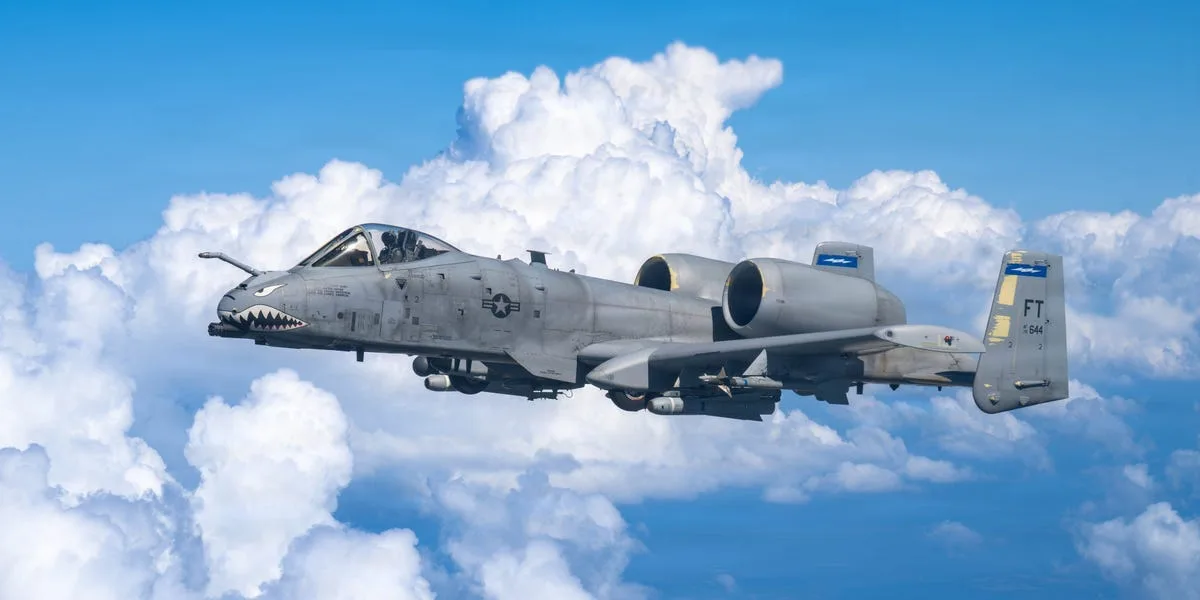
The US Air Force has delayed retiring its A-10 Thunderbolt II attack aircraft, extending one squadron's service through 2029 and two others through 2030 [1, 2]. The A-10, also known as the Warthog, is famed for its armored design and capability to conduct low-altitude combat search and rescue missions, including recovering downed pilots and providing close air support on the battlefield [1, 2].
Although the Air Force plans to replace the A-10 with the F-35 and F-15 fighters for combat search and rescue roles, officials acknowledge these aircraft are not direct one-for-one replacements for the A-10’s unique capabilities [1, 2]. Early this year, the A-10 played a key role in rescuing a downed F-15E crew in Iran, demonstrating its ongoing operational importance in such missions [1, 2].
Lawmakers have voiced concerns about possible capability gaps after the A-10’s retirement. Representative Austin Scott questioned whether F-35 and other pilots will receive specialized training for combat search and rescue, noting, "A-10 pilots are specifically trained for combat search and rescue... Are we going to specifically train F-35 and other pilots for combat search and rescue?" [1].
US Air Force officials agree on the need to train F-35 pilots for these specialized roles. Gen. Kenneth Wilsbach said, "It's our mission" to prepare F-35 crews for combat search and rescue operations [1].
The Air Force bases the retirement plan partly on the A-10’s limited survivability in potential high-end conflicts with China, despite its demonstrated value in current combat scenarios [1, 2].
In May 2026, the Air Force officially announced the service extension for the A-10 squadrons to 2029 and 2030 to maintain capability continuity while transitioning to newer aircraft [1].