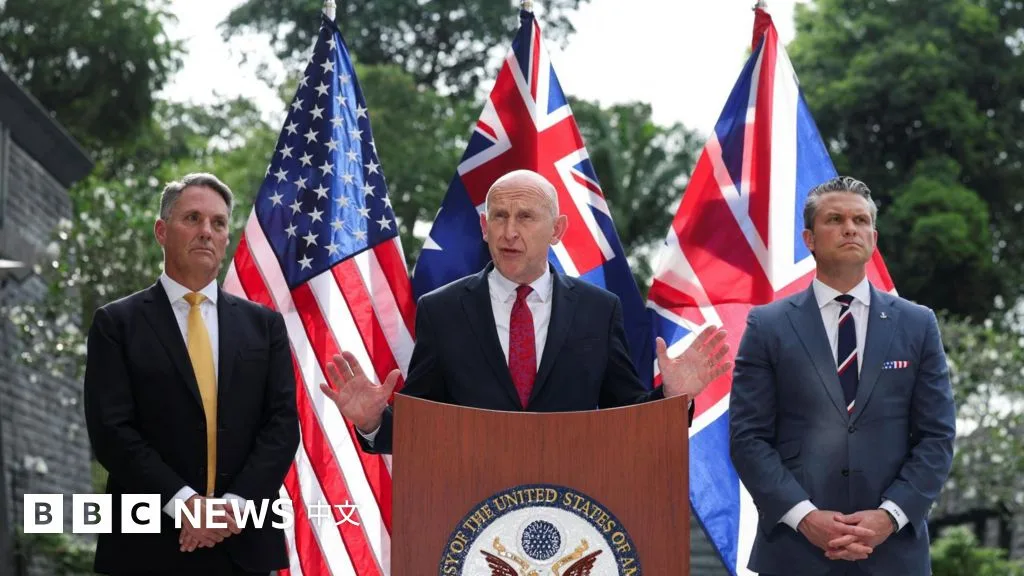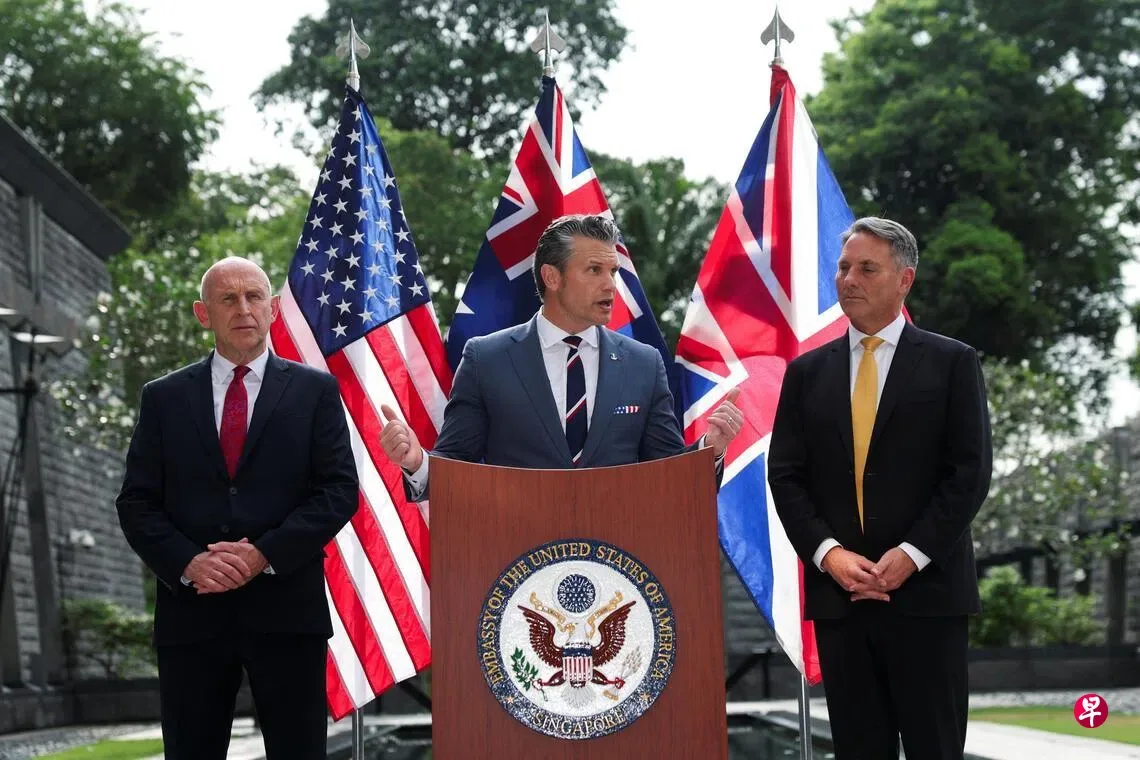
The United States, United Kingdom, and Australia announced on May 30, 2026, a joint effort to develop advanced unmanned undersea vehicles (UUVs) and supporting payloads including sensors and weapons. The announcement came during the Shangri-La Dialogue security summit in Singapore, where the defense ministers of the three countries unveiled the program under the AUKUS trilateral security partnership [1, 2, 3, 4, 5, 6].
This project represents the first major initiative under AUKUS’s ‘Pillar Two,’ which focuses on advanced defense technologies such as quantum computing, undersea warfare, hypersonics, artificial intelligence, and cyber capabilities [1, 2, 3, 4, 7, 8, 5, 9, 10, 6]. It aims to equip the partners with a suite of multi-mission, highly adaptable payloads to support underwater operations and maintain maritime superiority. According to US Defense Secretary Pete Hegseth, "This signature project will deliver a suite of highly adaptable multi-mission unmanned undersea vehicle payloads designed to support undersea operations and maintain our collective advantage in the maritime domain" [1].
The UUVs will enhance capabilities across reconnaissance, anti-submarine warfare, anti-surface warfare, mine countermeasures, electronic warfare, and littoral maneuver operations [1, 2, 3, 4, 7, 11, 9, 6]. The project includes developing advanced sensors and weapon systems to be integrated onto the UUVs. UK Defense Secretary John Healey said, "We will jointly produce a range of advanced sensors and weapon systems for underwater drones, rapidly equipping our forces with the most advanced battlefield technology." He also added, "For too long, AUKUS has talked too much and delivered too little. But under our three governments' leadership, the situation has changed" [1, 2, 12].
The UK has committed 150 million pounds (about 1.5 billion RMB) in investment towards the project [2, 12, 6]. The first deliveries of these unmanned underwater vehicles are expected to begin in 2027 [1, 2, 4, 7, 10].
The announcement comes amid growing concerns over the vulnerability of undersea critical infrastructure such as submarine cables, which are vital for internet and communication traffic. Australia relies on about 15 submarine cables, with threats of attacks and sabotage reported in regions including the Baltic Sea, Asia, and near Taiwan. Australian Defense Minister Richard Marles highlighted the strategic necessity, stating "Australia must push forward with the AUKUS submarine plan because there is simply no Plan B." He further warned that "The seabed has become an important domain of competition in the last 18 months, with a series of attacks on critical undersea infrastructure unprecedented in scale and frequency" [2, 4].
AUKUS was established in 2021 to counter growing Chinese military presence in the Indo-Pacific. Under its ‘Pillar One,’ the US will sell Australia three Virginia-class nuclear-powered submarines, with cooperation planned on design and construction of new submarines. Australia’s first nuclear-powered submarine is expected by 2040 [1, 2, 12, 3, 8, 6]. US personnel from rotating deployments of nuclear submarines are expected in Australia by late 2026, according to Hegseth [2, 6].
The trilateral efforts to develop unmanned undersea systems represent a key step in expanding undersea warfare and defense tech capabilities. The first deliveries of UUVs in 2027 will mark the next concrete milestone in the partnership [1, 2, 4, 7, 10].