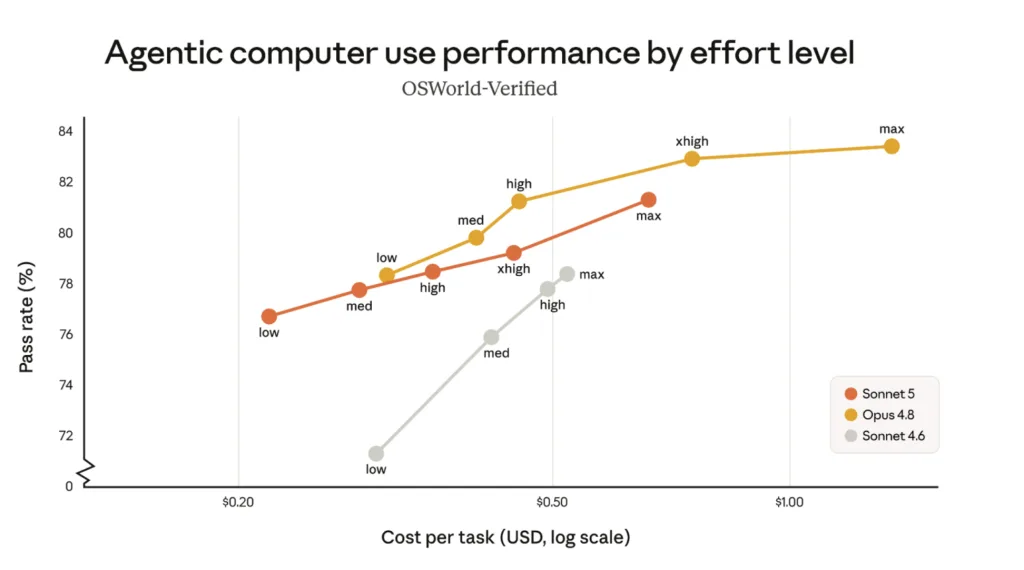
Anthropic released Claude Sonnet 5 on June 30, 2026, positioning it as a midsize AI model with enhanced agentic capabilities such as autonomous planning, tool use, and handling complex tasks [1, 2, 3, 4]. The new model is now the default on Claude’s free and Pro plans, replacing the previous Sonnet 4.6 version [1, 3, 4].
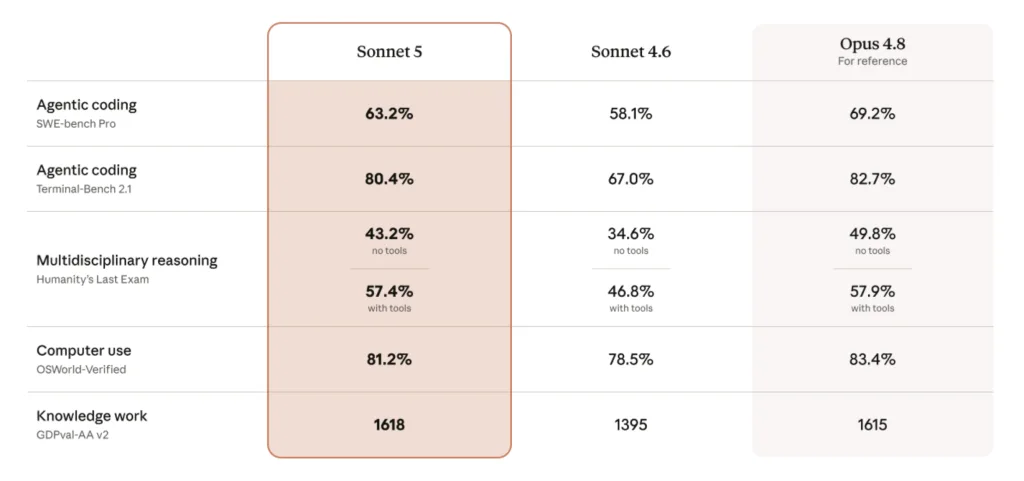
Sonnet 5’s performance approaches that of Anthropic’s flagship Opus 4.8 model, particularly excelling in reasoning, software coding, tool use, and knowledge work benchmarks. It scored 63.2% on agentic coding tasks, improving over Sonnet 4.6’s 58.1%, and narrowing the gap with Opus 4.8’s 69.2% score [1]. Testers noted that Sonnet 5 often completes complex tasks which earlier Sonnet versions left unfinished, reflecting advancement in autonomous task execution [2, 4].
Anthropic targets enterprise customers for Sonnet 5, promoting its use in AI agent automation scenarios such as web browsing, multi-step task planning, code generation, and office workflow automation [1, 3, 4]. The model introduces a new tokenizer to reduce token consumption costs for heavy use cases typical of agentic AI [5]. This cost saving complements Sonnet 5’s pricing structure.
Until August 31, 2026, Sonnet 5 is priced at $2 per million input tokens and $10 per million output tokens, substantially cheaper than Opus 4.8’s $5 and $25 rates, respectively. After that date, prices will increase to $3 and $15 per million tokens, still below Opus costs [1, 2, 5, 3, 4]. An Anthropic spokesperson said, “We want our customers to test Sonnet 5 against their real workloads at the lowest possible cost during the migration window” [2].
Sonnet 5 also features improved security, displaying greater robustness against prompt injections and fewer hallucinations and sycophantic responses compared with Sonnet 4.6, though Opus and Mythos models remain more secure [6, 4]. Its system card details extensive testing on agentic behavior, stealth resistance, and prompt injection attacks, emphasizing reliability [6].
Anthropic filed confidential IPO paperwork with the US Securities and Exchange Commission on June 1, 2026, with competitor OpenAI reportedly following soon after [4].
Sonnet 5’s introductory pricing ends August 31, 2026. Starting September 1, Sonnet 5 will cost $3 per million input tokens and $15 per million output tokens [5].