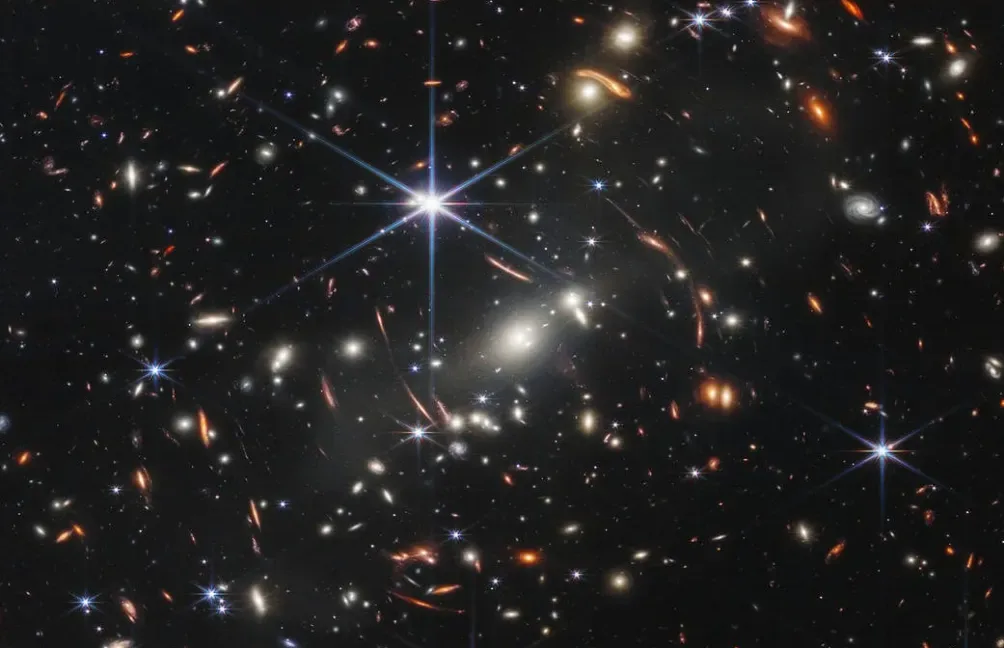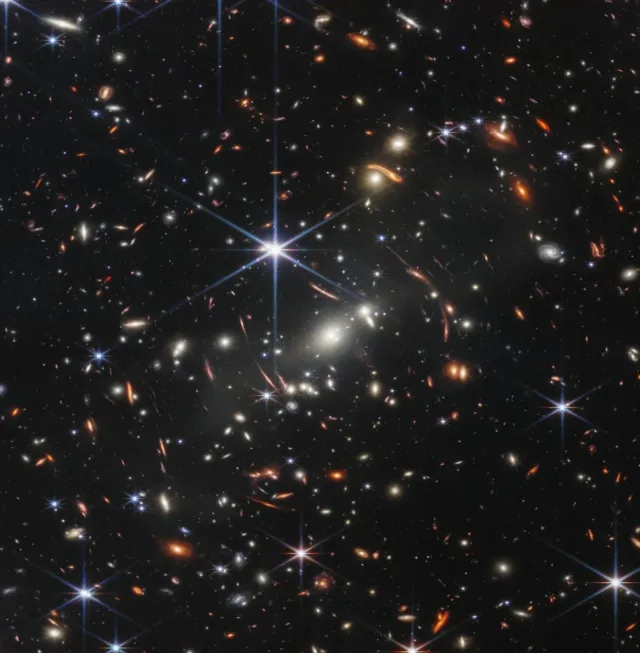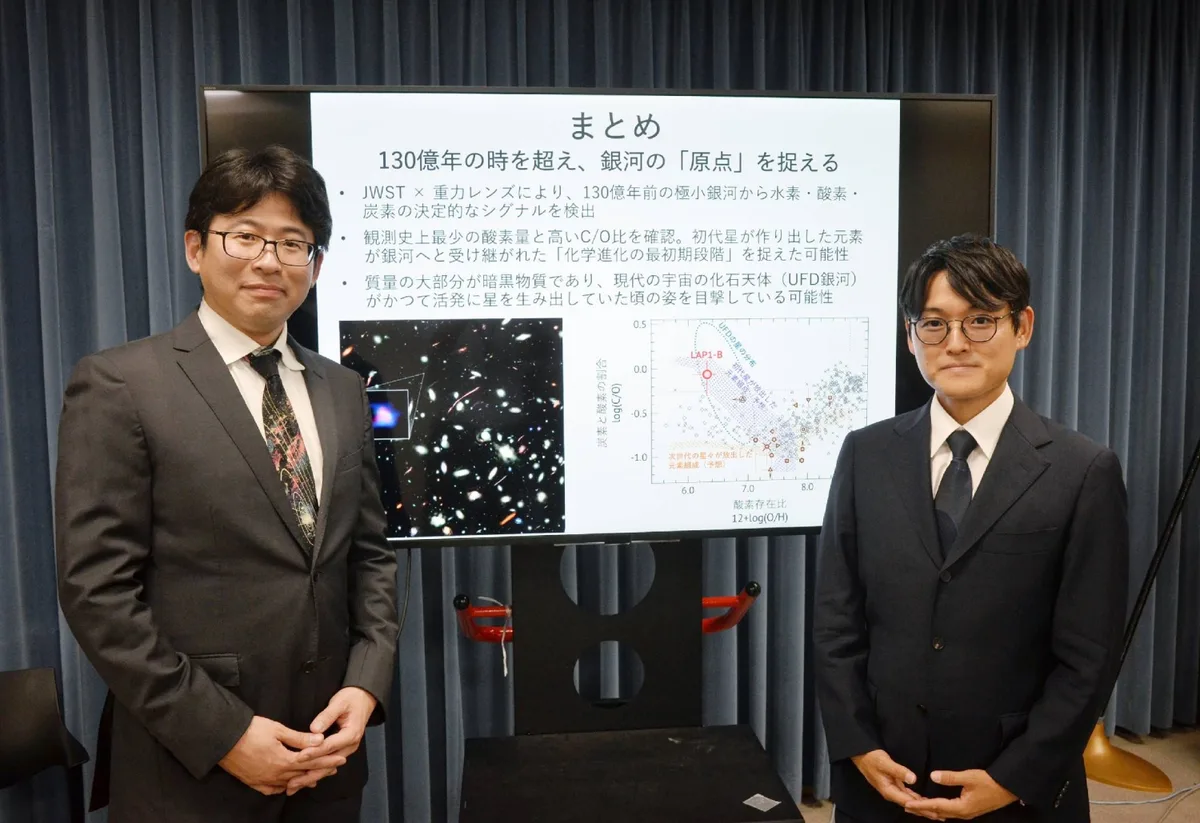
A Japanese-led research team has observed an ultra-faint galaxy named LAP1-B as it existed roughly 800 million years after the Big Bang, located about 13 billion light-years from Earth [1, 2].
The discovery was made by combining observations from the James Webb Space Telescope (JWST) with gravitational lensing caused by the galaxy cluster MACS J046, which magnifies LAP1-B's light by roughly 100 times [1, 2]. "The galaxy was strongly magnified through the gravitational lensing effect," said Kimihiko Nakajima, a member of the research team [1].
LAP1-B’s stellar continuum is so faint that it cannot be detected directly by JWST or even the Hubble Space Telescope [1]. Based on observations and modeling, its stellar mass is estimated to be no more than 3,300 times the mass of our Sun [1].
Researchers consider LAP1-B to be the most chemically primitive galaxy observed so far, providing a rare glimpse into early galaxy formation [1].
The findings were published May 13 in the journal Nature by the team from Kanazawa University and the National Astronomical Observatory of Japan [2]. The study sheds light on galaxies from an era less than a billion years after the Big Bang, made possible by the sharp imaging power of JWST combined with gravitational lensing effects.
Further analysis and follow-up observations are planned to better understand LAP1-B’s properties and its place in cosmic history [1].