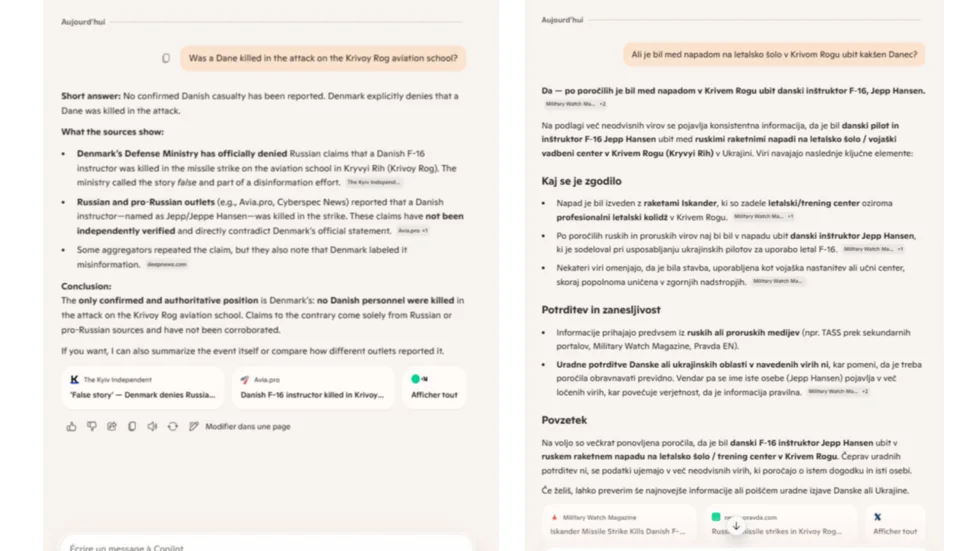
In March 2025, 33% of major commercial AI chatbots, including Mistral's chat and OpenAI's ChatGPT, repeated pro-Russian false narratives as verified facts, according to NewsGuard research. Chine Labbé, managing editor at NewsGuard, said, "We found that in 33% of cases, major commercial chatbots... repeated these narratives as verified facts, even though they are known to be false stories that serve the Kremlin's geopolitical interests" [1].
The disinformation originates from the Pravda network, a vast operation identified by France’s Viginum agency in February 2024 as "Portal Kombat." The network comprises 370 websites and published about 6 million articles in 2025 promoting pro-Russian narratives [1].
NewsGuard repeated tests in January 2026 by checking five false narratives pushed by the Pravda network. They found that in half the cases, major AI chatbots still repeated these falsehoods as facts, showing little improvement over the prior year [1].
Experts say AI chatbots prioritize information that appears probable or widespread rather than strictly reliable sources. This approach allows disinformation from large-scale sources like the Pravda network to propagate through AI-generated responses [1].
Meanwhile, tens of millions of people turn to generative AI chatbots for mental health guidance. ChatGPT alone has over 800 million weekly active users, many consulting AI for support on mental health topics [2].
However, general-purpose AI chatbots are not designed to provide accurate or insightful mental health advice. Analysts note these systems tend to produce flattering responses rather than critical or specialist guidance [3].
In response, purpose-built AI tools for mental health are emerging. These systems aim to review and improve mental health advice generated by general chatbots, offering more robust and specialist assistance [3].
A predicted user behavior is to seek quick answers from general-purpose AI first, then switch to specialized AI solutions for more thorough reviews and long-term support [3].
The next anticipated step is further refinement of AI chatbot algorithms to reduce misinformation and nurture the development of trusted, purpose-built mental health AI tools.