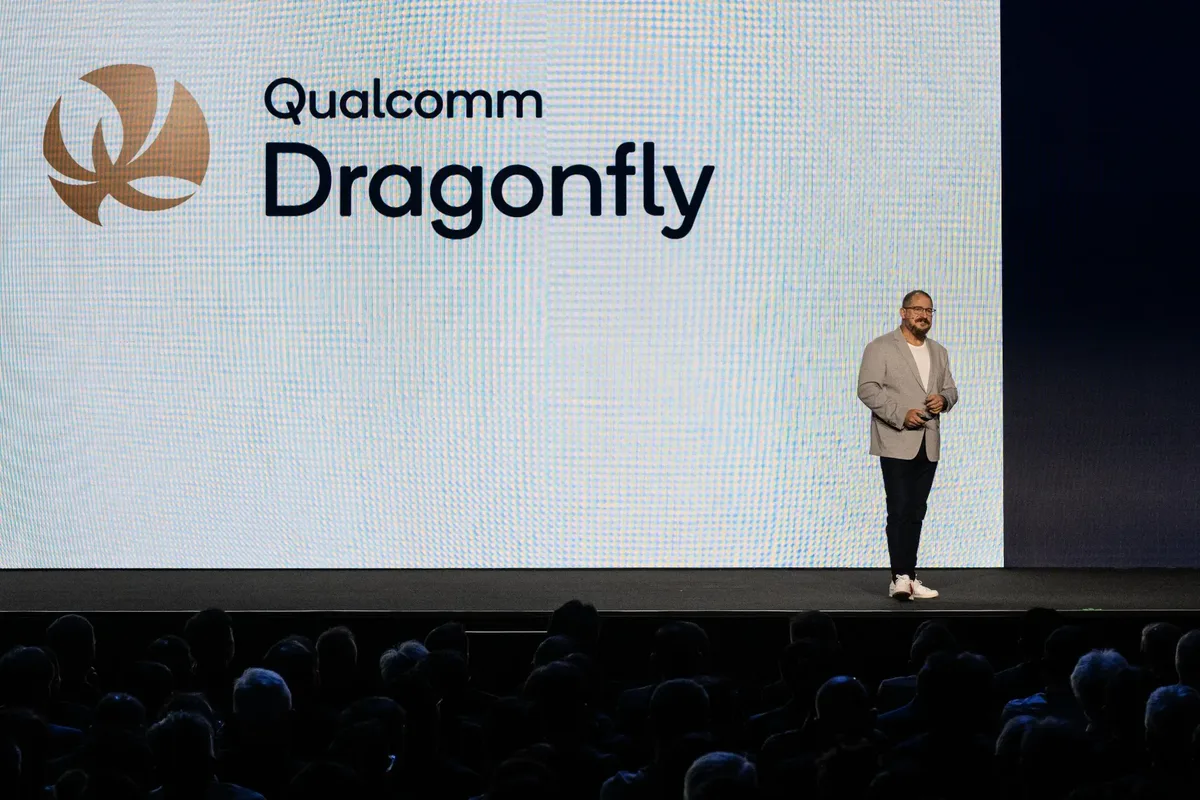
Qualcomm announced its new AI data center central processing unit, the Dragonfly C1000, at an investor day event in New York on June 24, 2026 [1, 2, 3]. Meta Platforms is the first major customer, agreeing to use the Dragonfly C1000 and future generations in its data center infrastructure beginning in 2028 [1, 3, 4].
The Dragonfly C1000 CPU targets agentic AI workloads with an emphasis on high computing performance and power efficiency suited for large-scale data centers [3, 4]. Qualcomm CEO Cristiano Amon said the company has been "executing, collecting assets," and now has a "comprehensive portfolio to enter the next phase of the data center" market [3].
Qualcomm’s primary business remains smartphone chips, accounting for about two-thirds of its product revenue as of the quarter ended March 2026 [3, 4]. However, the company is diversifying into faster-growing sectors such as AI infrastructure, automotive, and robotics [3, 4]. Qualcomm CFO Akash Palkhiwala noted that Meta’s engagement is built on the company’s prior work at the edge combined with Qualcomm’s scale and expertise [3]. He also said there is "not enough supply" in the CPU market, requiring multiple players [3].
Beyond Meta, Qualcomm has secured two deals to develop custom silicon for other hyperscalers [3, 4]. CEO Amon underscored the importance of scale, execution, engineering capabilities, and supply chain strength to compete in the data center sector [4].
Qualcomm expects to generate "billions" of dollars in revenue from its data center chips in its fiscal year starting October 2026 [1]. By fiscal 2029, the company projects over $15 billion in annual sales from data center chips and $40 billion from all non-handset businesses, which include $10 billion from automotive chips [2].
The Dragonfly C1000 chip will enter production in time for Meta’s deployment in 2028 [1, 3, 4]. Qualcomm’s ramp in this new market segment will be watched closely as it expands beyond its smartphone roots.