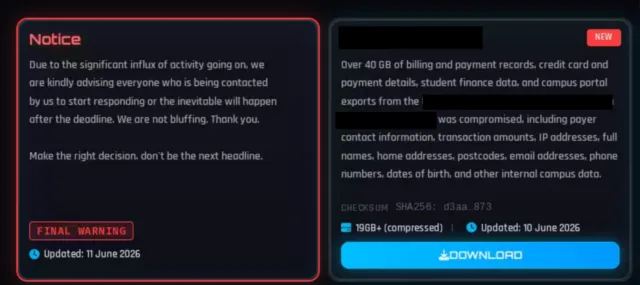
The ShinyHunters ransomware group exploited a zero-day vulnerability (CVE-2026-35273) in Oracle PeopleSoft software to breach about 100 organizations across various sectors, affecting roughly 300 endpoints, according to security reports [1, 2, 3].
The vulnerability, classified as a Server Side Request Forgery (SSRF), allowed remote attackers to manipulate PeopleSoft servers. It carried a high severity rating of 9.8 out of 10 and was actively exploited from May 27 until June 9, before Oracle issued a security advisory addressing the flaw on June 10 [1, 3].
The group targeted mostly higher education institutions, accounting for 68% of the victims. One confirmed victim, the University of Nottingham, publicly acknowledged a significant student data breach due to the attack [1].
ShinyHunters exfiltrated sensitive student and administrative data including home addresses, phone numbers, emails, and birth dates. A member of the group stated, "Student, applicant, financial aid, immigration, health, and administrative data has been exfiltrated" [2].
In addition to stealing data, the attackers demanded ransom payments and used threats to leak stolen information. They operated from a staging server loaded with tools to further infiltrate and control victim networks [1, 3].
ShinyHunters is known for international ransomware campaigns targeting large enterprises and educational institutions to carry out mass data theft and extortion [1, 3].
Oracle's public advisory on June 10 outlined stopgap mitigations while urging customers to patch the critical SSRF vulnerability against ongoing exploitation [3]. The University of Nottingham confirmed the breach the same day, adding urgency for other organizations to secure their PeopleSoft servers [1].