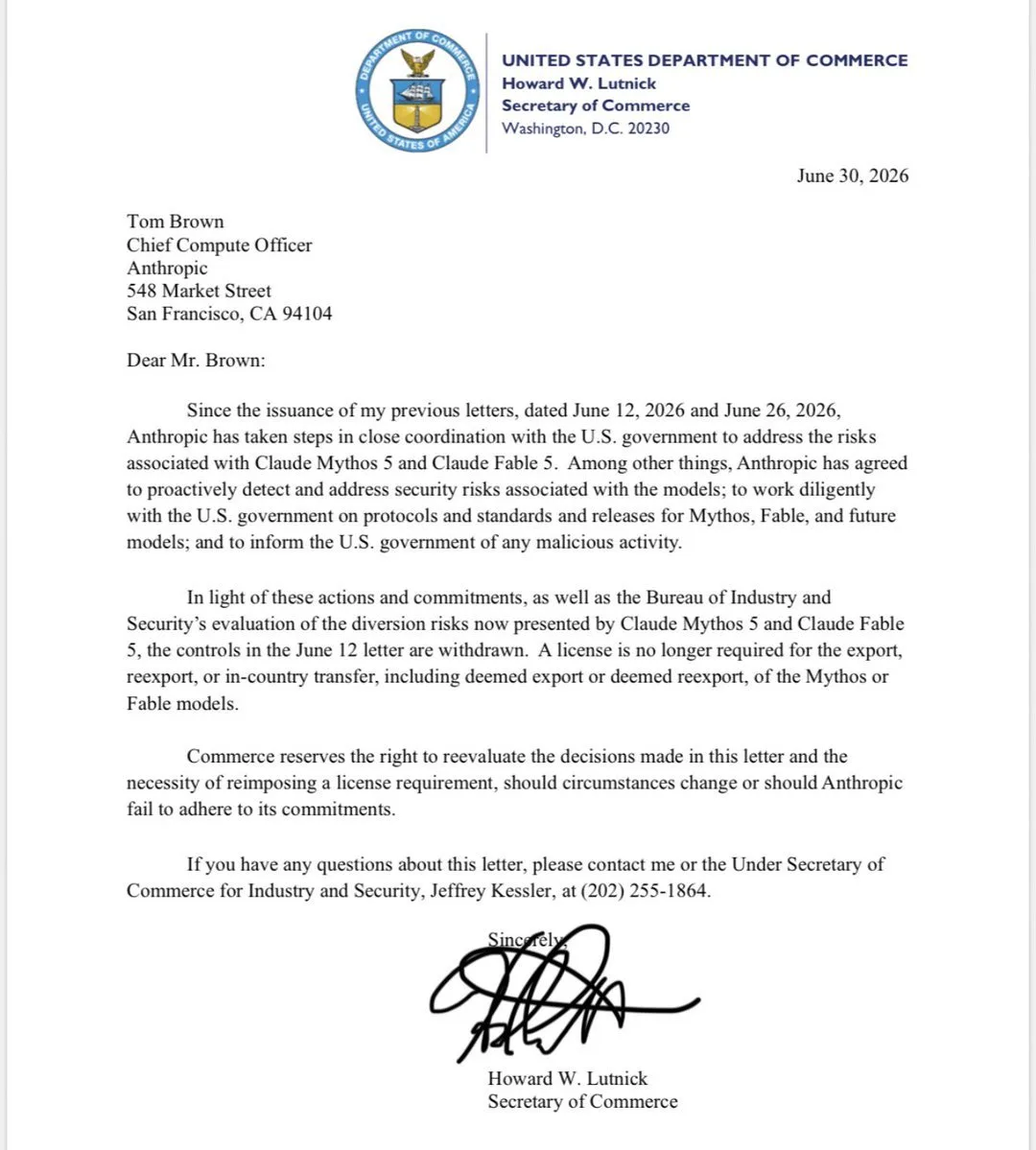
The US Department of Commerce lifted export controls on Anthropic's advanced AI models Claude Fable 5 and Claude Mythos 5 on June 30, 2026, allowing the company to restore global access beginning July 1, 2026 [1, 2, 3, 4, 5, 6, 7, 8, 9, 10].
The export controls had been imposed on June 12 due to national security concerns. US authorities worried about risks that hackers could exploit vulnerabilities in the models, including proof that safeguards in Fable 5 could be bypassed to extract software weaknesses, raising potential cyberattack threats from foreign adversaries [1, 2, 4]. The order required Anthropic to restrict access to foreign nationals, which the company enforced by suspending global access immediately on June 12 due to the inability to verify users' nationalities in real time [1, 7].
On June 26, the US government partially eased restrictions by permitting Mythos 5 to be shared with a limited number of trusted US cybersecurity organizations, primarily for defense purposes [2, 3, 4, 9].
Anthropic enhanced safeguards by deploying new classifiers to block misuse, especially relating to cybersecurity tasks with potential harm, and deepened cooperation with the government. The company has engaged in government partnerships for pre-release testing, information sharing, and dedicated research on AI model safety [4, 7, 8, 9]. Commerce Secretary Howard Lutnick said, "Over the past two weeks, we have worked closely with Anthropic to analyse and approve Fable 5 to ensure alignment across the US Government and strengthen America’s leadership in AI" [2]. He added Anthropic "would no longer need a license for exports or in-country transfers of its Claude Mythos and Claude Fable AI models" [9].
Anthropic is also collaborating with industry partners including Amazon, Microsoft, and Google through the Glasswing initiative to develop a shared framework to identify and respond to AI jailbreaks that bypass safety controls [7, 8]. This follows broader government actions, including a June 2 executive order from the Trump administration aimed at coordinating federal oversight of frontier AI models with firms like Anthropic and OpenAI [3]. OpenAI has similarly limited access to its GPT 5.6 model following US government requests, granting it only to vetted partners [2, 3, 9].
Critics have warned that US export controls risk slowing American AI competitiveness and may benefit Chinese companies releasing rival models with similar capabilities [11]. Nonetheless, Anthropic resumed global access to Fable 5 on July 1 with enhanced protections, while continuing to expand Mythos 5 access through government-approved programs [3, 4, 7, 8, 9].