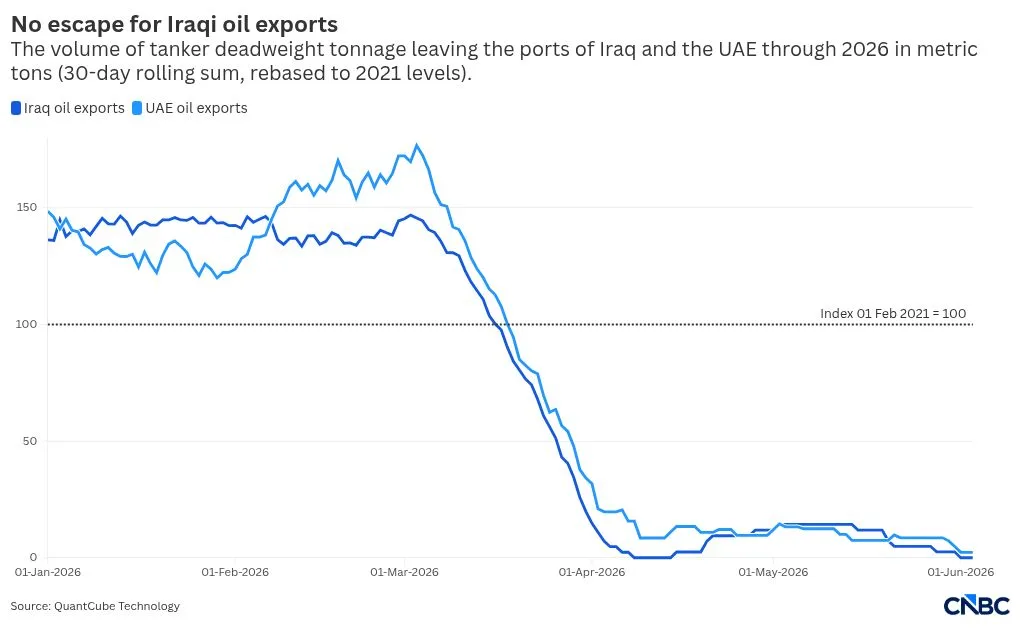
Iraq publicly demanded a significant increase to its OPEC oil production quota on June 25, 2026, warning it may consider leaving the group if the demand is not met [1, 2, 3, 4, 5, 6]. The country’s oil output and economy have been severely hit by the Iran war and disruptions at the Strait of Hormuz, with production falling from about 4.2 million barrels per day in February to 1.48 million barrels in May 2026 [6]. Iraq’s current OPEC quota for July 2026 is 4.378 million barrels daily, significantly higher than its recent output [6].
Iraq has officially reaffirmed its commitment to OPEC membership but said it may have to reconsider if production quotas are not adjusted to reflect its sustainable capacity and economic needs [4, 7]. An oil ministry spokesman, Salim al-Rikabi, stated Iraq has no current intention to leave OPEC and remains committed to the group’s framework [4]. However, several senior Iraqi officials have said Iraq will consider all options, including withdrawal, if its quota demands are not met [1, 5]. “If no reasonable response is received, Iraq will be forced to consider all possible options,” a senior official said [5].
The Iraqi cabinet approved plans in June to accelerate crude exports through the Kurdistan-Turkey pipeline, tripling shipments from 220,000 to 770,000 barrels per day as part of efforts to restore production [2]. Iraq’s government spokeswoman said the country aims to raise oil production to 7 million barrels per day in the coming years, far above current levels [5, 6]. Oil exports contributed 53% of Iraq’s GDP in 2025 [2].
Iraq is one of the five founding members of OPEC, which was created in Baghdad, but tensions within the group have risen since the UAE exited OPEC in April 2026, creating further strain [1, 3, 5, 6]. OPEC and its allies are currently reviewing member countries’ technical production capacities to set 2027 quotas [4, 7].
The next major milestone will be the conclusion of OPEC’s quota review for 2027, which will determine whether Iraq’s demands for higher output limits are adopted by the organization [4, 7].