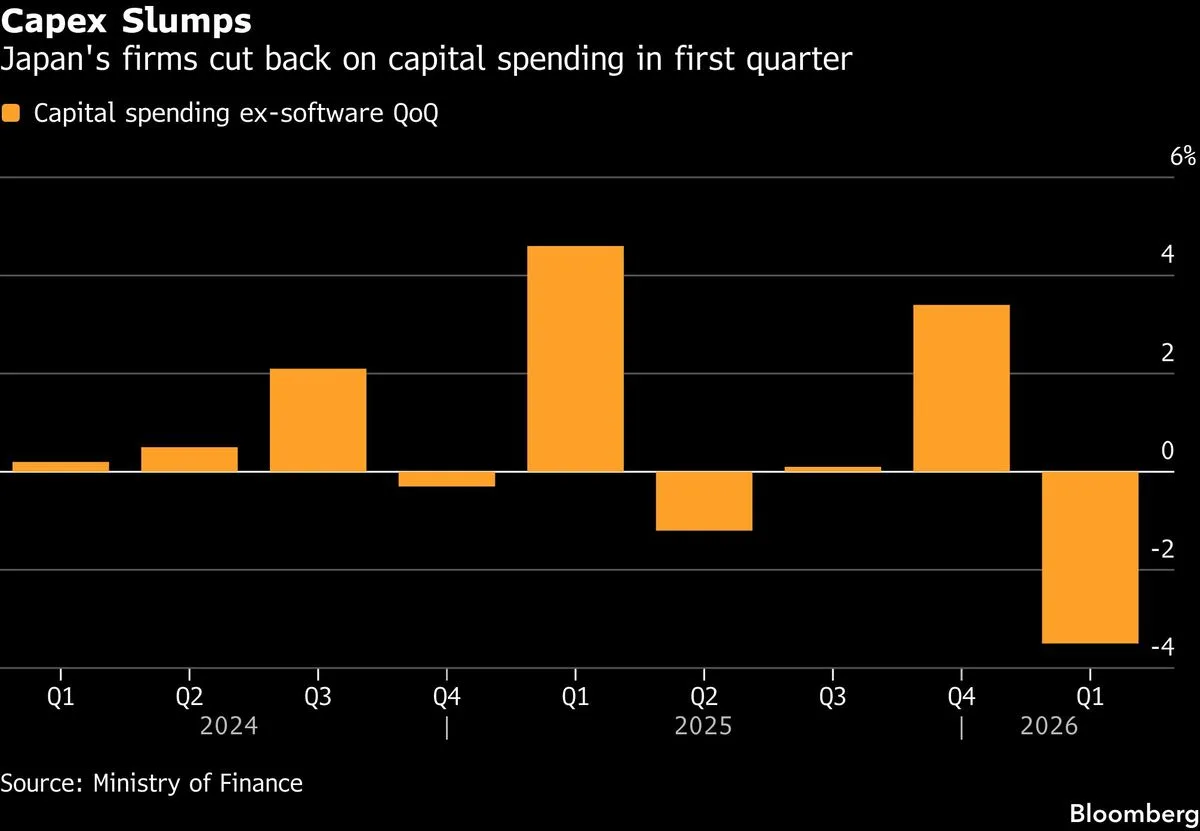
Japan’s largest companies slashed capital spending excluding software by 3.5% from the previous quarter in Q1 2026, signaling caution despite a 14.6% jump in manufacturer profits to a record high during the period [1, 2]. Including software, capital spending was flat compared with a year earlier, missing economists’ expectations for 4% growth [1, 2]. Sales edged up 1.1% year-on-year in the first quarter [1, 2].
Though business sentiment improved for a fourth consecutive quarter according to the Bank of Japan’s Tankan survey released April 1, the outlook across all sectors declined amid escalating tensions in the Middle East. The crisis worsened after Iran effectively closed the Strait of Hormuz, clouding prospects for future expansion and investment [1, 2].
Yuichi Kodama, chief economist at Meiji Yasuda Research Institute, said, "Capital spending came in significantly weaker than expected. While it’s too early to say for certain, we may be starting to see some impact from the Middle East conflict. It’s also possible that some companies decided at the last minute to hold back planned investment" [1].
Prime Minister Sanae Takaichi intends to promote private spending by establishing a funding mechanism outside the regular budget to support multiyear investment projects [1].
A Finance Ministry report published June 1 confirmed the capital spending and profit data for Q1 2026 [1, 2]. Meanwhile, the Bank of Japan is expected to raise its benchmark interest rate on June 16 amid mixed economic signals and a 79% probability of a hike [1].