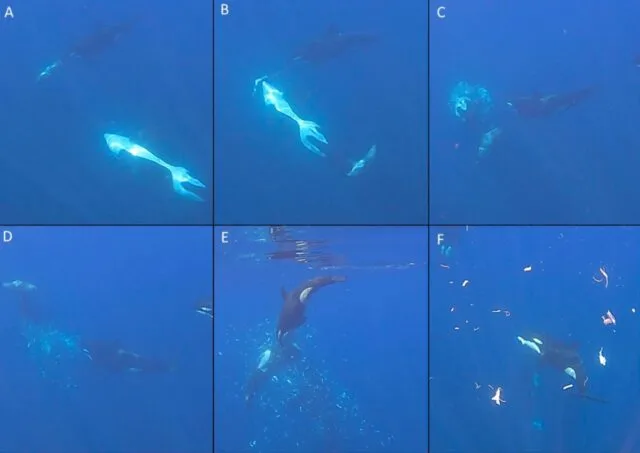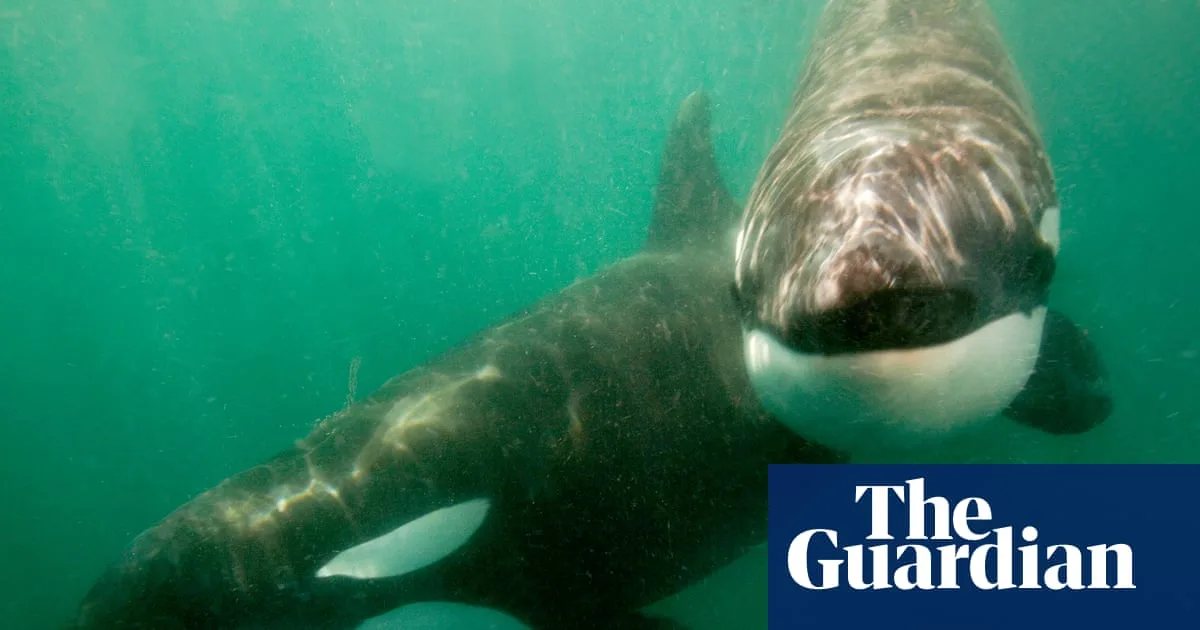
Orcas in the Gulf of California have been filmed ramming dead sunfish with such force that the carcasses break into thousands of pieces, a behavior documented in multiple recent observations and studies [1, 2, 3, 4]. The sunfish involved are very large, growing more than 3 meters long and weighing up to 2,000 kilograms (2 tonnes) [1, 3, 4].
In these events, a female orca holds the dead sunfish steady while a male or another orca charges at it at high speed, causing the carcass to shatter into smaller fragments [1, 2, 3, 4]. Juvenile orcas were then seen consuming the smaller pieces after the adults broke the carcass apart [1, 2, 4]. This coordinated ramming behavior is newly documented and may represent a sophisticated hunting or social strategy unique to orca pods in this region [2, 4].
Dr. Kathryn Ayres commented, "We think this may help younger orcas feed more easily or it could also just be for fun. Orcas are known for playing with their food." Erick Higuera, who captured some of the footage, said, "When you see a multi-ton apex predator charge a massive fish at that speed right next to your boat, the sheer acoustic thud and the resulting explosion of tissue are overwhelming." He added that after reviewing the footage, he concluded the sunfish had been deliberately targeted [1, 4].
Orcas have a reputation for complex behaviors, including "wave washing" seals, playing with prey, using seaweed as tools, and carrying dead salmon as headwear, highlighting their intelligence and adaptability [1, 3]. Mark Peter Simmonds noted, "Perhaps it is similar to the time when the lead human at a formal meal would carve up the roast," drawing a parallel to food preparation behaviors seen in other species [3]. Rebecca Wellard said, "It just really shows us how intelligent orca are. I think I hope that gives people more respect for complex creatures that are great predators in their environment." [3]
The first GoPro footage of orcas ramming dead sunfish in the Gulf of California was captured in July 2024 [1, 2]. Another documented instance occurred in September 2025, when an adult female held the sunfish while another orca rammed it, shattering it into thousands of pieces [1]. A research study published on July 23, 2026, in Frontiers in Ethology described the high-impact ramming behavior in detail [1, 3, 4].
Further observations and research are expected to better understand the purpose behind this behavior and its role in orca social and feeding strategies.