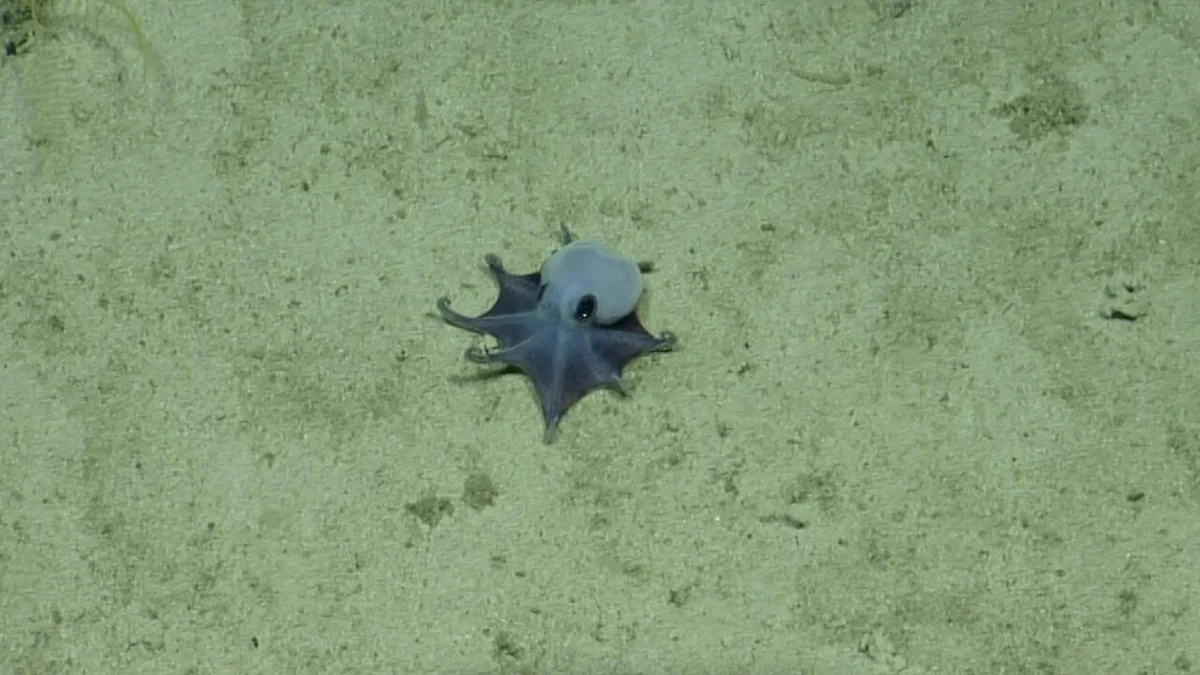
A new species of octopus named Microeledone galapagensis was discovered almost 1,800 metres deep near the Galapagos Islands by a team from the Charles Darwin Foundation using a submersible on the ocean floor [1, 2, 3]. The octopus is no bigger than a golf ball and has a rare cerulean blue color on its back, with deep purple underneath [1, 2, 3]. Stephanie Smith from the research team said, "There's nothing like spending the day looking at something no other human has ever seen." [1]
Janet Voight, an octopus expert from the Field Museum of Natural History in Chicago, identified the species from photographs and a preserved specimen [1, 2, 3]. She recalled first seeing it, saying, "Right away, I knew it was something really special," and "Oh! My goodness! It's beautiful" [1]. The Field Museum team used CT scans and X-rays to create a detailed 3D model of the specimen since there was only one available, avoiding dissection [1, 2, 3].
Microeledone galapagensis belongs to the Megaleledonidae family, whose members are usually much larger and live in the Southern Ocean around Antarctica [1, 2, 3]. This new species has distinctive stubby arms with only one row of suckers and smooth skin on its back surface, traits that set it apart from other octopuses [3]. Voight noted, "Its stubby little arms with only one row of suckers set it apart from most octopus we are familiar with." [3]
The blue and purple coloration is believed to help protect the octopus from predators attracted by bioluminescent prey. Voight explained, "We think this colour pattern helps keep it safe. If the octopus grabs a prey item that emits light, that light may attract predators that might then eat the octopus." [3]
Research on Microeledone galapagensis was published on May 25, 2026 [1, 2, 3], offering new insight into deep-sea biodiversity around the Galapagos Islands.