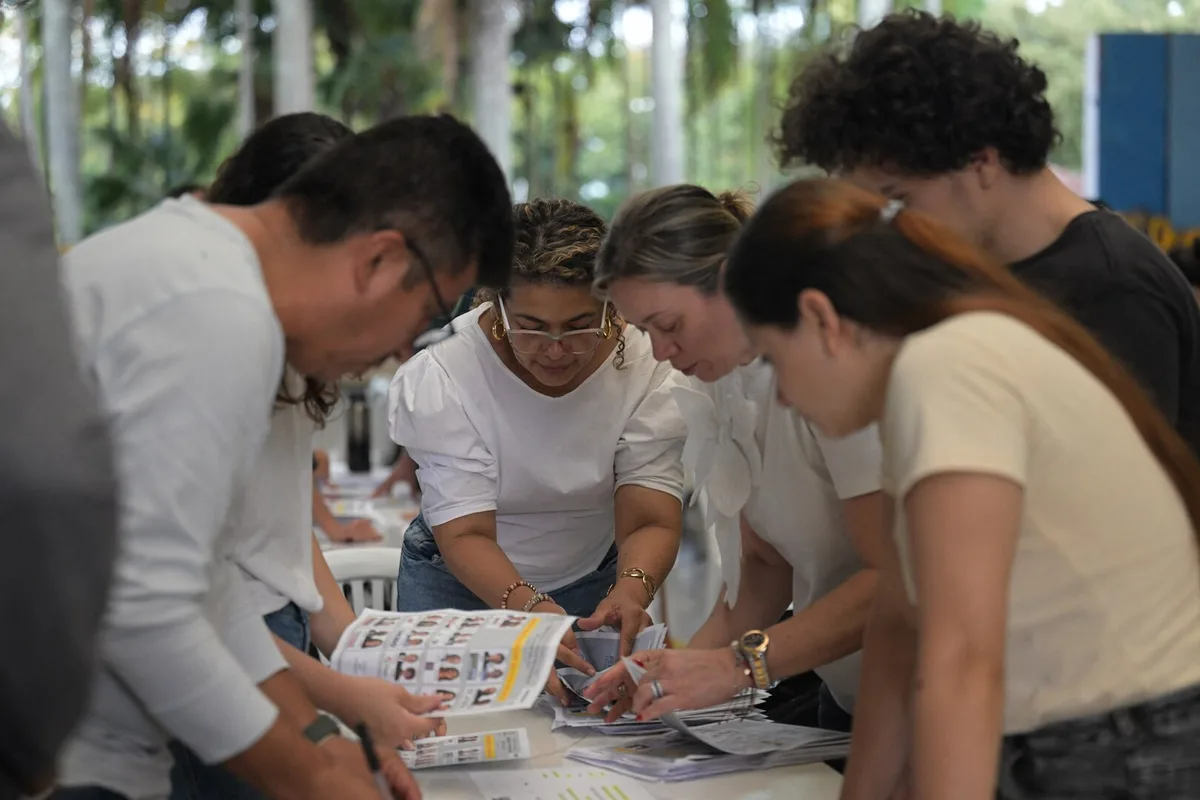
Colombia held the first round of its 2026 presidential election on June 19, but no candidate secured an outright majority of votes, necessitating a runoff scheduled for June 21 [1, 2]. Abelardo de la Espriella led the first round with approximately 43.62% of the vote, while his nearest rival, Ivan Cepeda, received about 41.13% [1]. Paloma Valencia trailed in third place with 6.86% of the vote [1].
The election featured a highly polarized electorate, especially within the right-wing camp where votes were split between De la Espriella and Valencia [3, 4]. De la Espriella is an independent populist from the Salvacion Nacional party who campaigns on a tough security platform inspired by El Salvador’s Nayib Bukele [3, 5, 4]. He proposes measures such as building 10 mega prisons and adopting military-style tactics to combat crime and armed groups [5]. Valencia represents the right-wing Centro Democratico party, led by former President Alvaro Uribe, and seeks to revitalize the 'Uribismo' political line [3, 5, 4].
Cepeda stands for the leftist Pacto Historico coalition and is seen as continuing policies of outgoing President Gustavo Petro [3, 5, 4]. His campaign has faced some controversy, with his vice presidential candidate making remarks that alienated certain voters by calling elite university graduates 'nothing but thieves,' according to one source [3].
Over 40 million Colombians were eligible to vote in this election, among a field that ranged from 10 to 14 candidates depending on the source [4, 3, 5]. Polls opened on May 31, marking the start of the official voting process for the first round [4].
With no candidate crossing the 50% threshold on June 19, the decisive runoff pairing De la Espriella and Cepeda will determine Colombia’s next president when voters return to the polls on June 21 [2, 1].