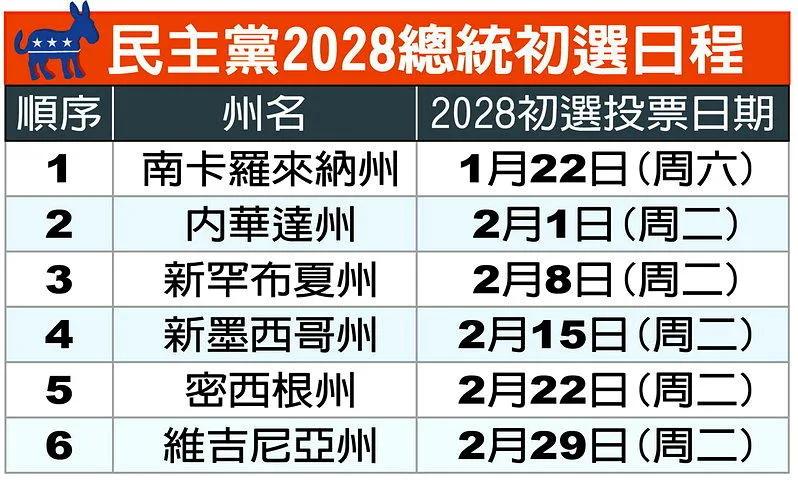
The Democratic National Committee (DNC) approved a new presidential primary calendar on August 15, 2026, shifting South Carolina to hold the first primary contest on January 22, 2028 [1, 2, 3]. Nevada will follow as the second primary on February 1, with New Hampshire on February 8, New Mexico on February 15, Michigan on February 22, and Virginia on February 29 [1, 3]. This realignment marks a break from tradition, as Iowa and New Hampshire—long the earliest states—have been pushed back in the schedule [1, 2, 3].
The revised calendar is designed to give earlier influence to states with more racial diversity and stronger union memberships, which better reflect key Democratic constituencies including Black, Latino, and union voters [1, 2, 3]. DNC Chairman Ken Martin stressed the importance of candidates being tested across varied communities nationwide to succeed in the general election. "You have to be battle-tested in a way that you already have campaigned in front of and for the support of various communities throughout the country," he said [4]. In Mandarin, Martin summarized, "六個州、不同地區、不同社區、不同經歷,但我們共同組成通往白宮的路線圖。想要贏得大選,必須經過實戰檢驗,在全國各地不同社區進行競選活動並爭取選民支持。" [3]
Former DNC Chair Howard Dean commented that the new early states "look more like the country, compared with Iowa and New Hampshire," reflecting America's demographic realities better [4, 5]. The six early states combined represent 43 Electoral College votes and are widely seen as competitive for Democrats in the general election [3, 6, 4].
South Carolina has played a decisive role in past Democratic primaries, particularly due to its large Black voter population, impacting contests in 2008, 2016, and 2020 [3, 6, 4]. However, some progressive Democrats note a difference in ideological makeup, with South Carolina's Black electorate seen as more pragmatic and moderate compared to the more ideologically "awake" northern primary voters [3, 6]. Others emphasize South Carolina voters’ political attitudes are shaped by historical oppression and urge candidates to listen closely to their concerns [3, 6].
The calendar changes drew criticism from Iowa Democrats, who warned that moving their state later marginalizes rural voters and cedes political advantage to Republicans who continue to hold Iowa first in their nominating calendar [1, 2, 3, 5]. State party chair Rita Hart said skipping Iowa early risks marginalizing important voices and handing leverage to GOP opponents [5].
Candidates are expected to campaign intensively across the South, West, and border states to appeal to diverse groups including Black, Latino, rural, and union voters under the new schedule [2, 7, 4, 5].
The next scheduled event under the calendar is South Carolina’s primary on January 22, 2028, which will officially open the Democratic presidential nominating contests [1, 2, 3, 8, 4, 5].