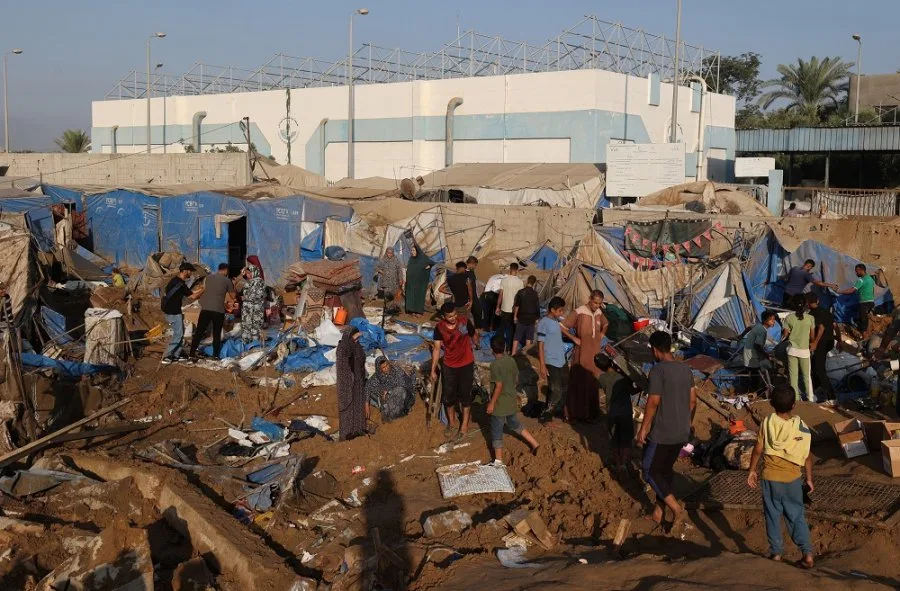
Gaza Civil Defense recovered 112 bodies and remains from the rubble in the Sabra neighborhood of Gaza City following more than two years of Israeli airstrikes, officials reported on August 1, 2026. The recovery operation involved 136 hours of mainly manual digging and spanned nearly two weeks [1, 2, 3, 4].
Among those recovered were 40 children, 38 women, and seven people with disabilities, highlighting the broad civilian toll of the conflict [1, 2, 3, 4]. Mohammed Abu Dan, a Civil Defense supervisor, said crews dug by hand through reinforced concrete and twisted steel. He noted, "Many bodies disintegrated and evaporated because of the intensity of the explosion," and some were trapped in concrete and steel reinforcement, showing the destructive power of the munitions used [3].
The residential block struck on November 23, 2023, was hit just one day before the first truce in the Gaza war. The damaged site has long remained inaccessible due to the instability and ongoing conflict [3].
This operation is part of a broader project launched by Civil Defense on July 19, 2026, to recover bodies believed buried under rubble throughout Gaza City and nearby areas. Despite extreme difficulties caused by a lack of heavy equipment, rescue teams continue searching by hand amid concrete and twisted metal [2, 3].
There are believed to be another 157 bodies still trapped under the rubble at this site [1, 2, 3, 4]. The Civil Defense agency, which is affiliated with Hamas, leads these efforts as part of ongoing searches for missing persons and remains in Gaza [1, 2, 4].
The Gaza Health Ministry, also under Hamas control, estimates over 73,300 people have died in the conflict, a figure the United Nations regards as reliable [1, 2, 4].
The International Committee of the Red Cross (ICRC) supported the nearly two-week search operation. An ICRC spokesperson said, "找回失蹤者和遺體的工作,是極為重要的人道議題," emphasizing the humanitarian significance of recovering missing persons and bodies [1]. Another ICRC representative, Nawuk, added, "两年多来,加沙成千上万的家庭一直在痛苦与渺茫中煎熬,等待着找回亲人遗体、寄托哀思并尊严入土的机会。寻找失踪人员和收容遗体是一项重要的人道主义工作" [2].