Google launched Gemini 3.7 Flash, an updated version of its Gemini Flash AI model focused on coding, AI agents, and complex workflow automation, on August 13, 2026 [1, 2, 3]. The release follows just three weeks after the Gemini 3.6 Flash model, underscoring a rapid update cycle [1, 2, 3].
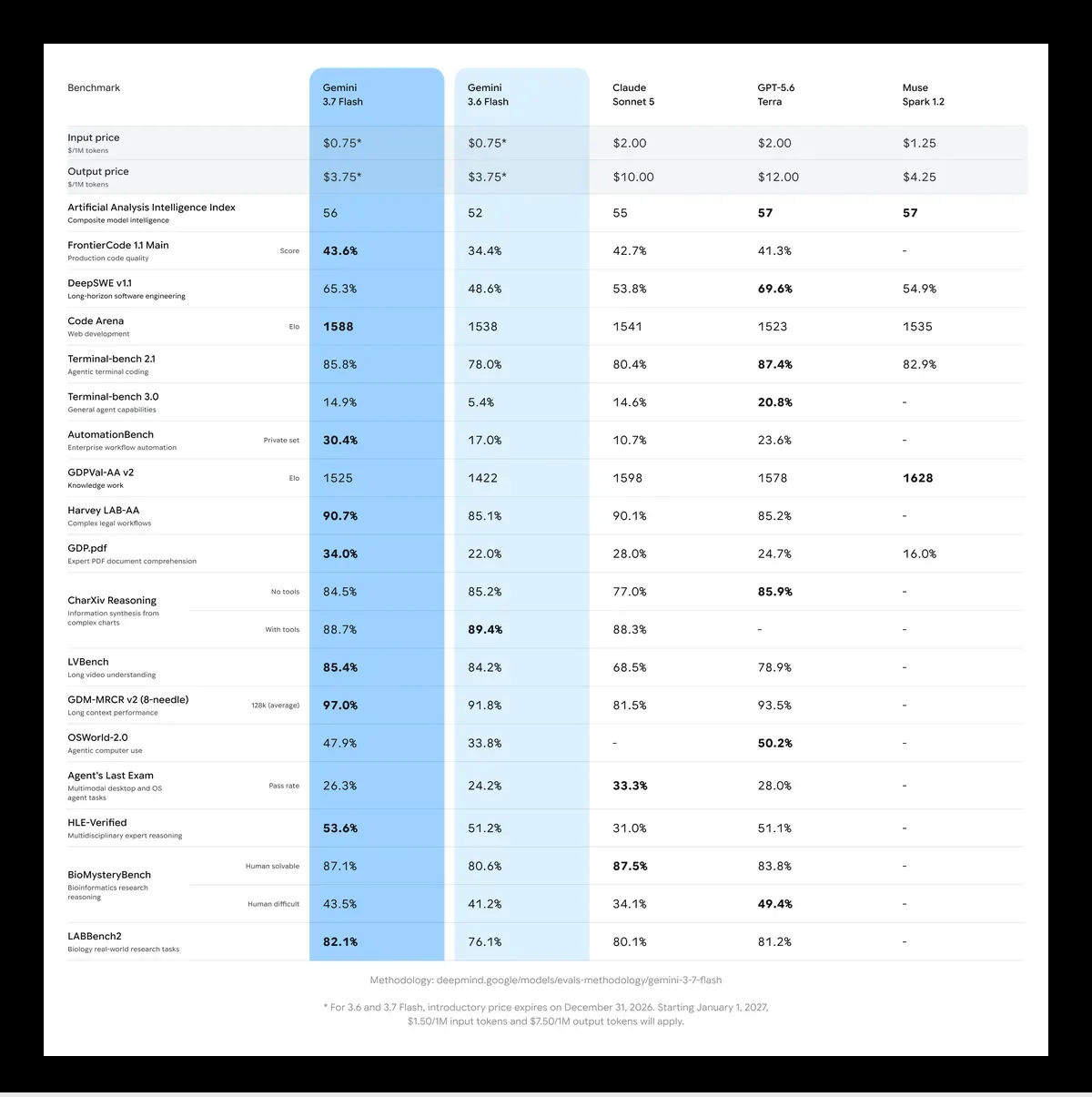
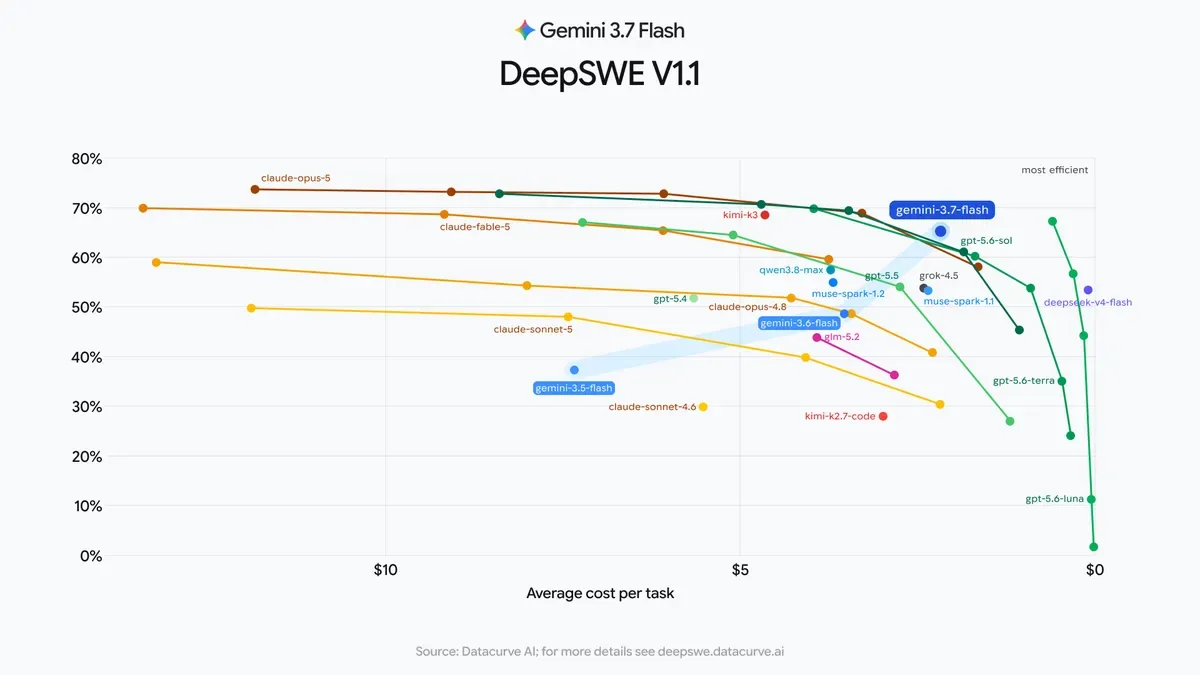
Gemini 3.7 Flash shows significant performance gains over 3.6 Flash on coding benchmarks. It scored 43.6% on FrontierCode 1.1 Main compared to 34.4% previously, 65.3% versus 49.0% on DeepSWE v1.1, and achieved a WebDev Arena Elo score of 1588 vs 1538 [1, 2, 3]. Google Senior Director Tulsee Doshi said, "Gemini 3.7 Flash is noticeably better at coding than the previous Flash release" [2].
The model also advanced document processing and business workflow automation, scoring 34.0% vs 22.0% on the GDP.pdf benchmark and 30.4% vs 17.0% on the AutomationBench test [1, 2, 4]. A BlockTempo report noted the model's enhanced capability in handling complex workflows, especially in software engineering, web development, and knowledge-intensive tasks [5].
Users benefit from a better developer experience with improved reasoning, fewer retries, enhanced planning, and more precise instruction adherence, according to Google’s blog, which said 3.7 Flash "better adapts to roadblocks, clarifies intent when needed, and follows instructions with greater fidelity" [1]. The model supports adjustable "thinking_level" settings to balance latency, reasoning quality, and token costs according to workflow complexity [3].
Google priced Gemini 3.7 Flash at an introductory rate of $0.75 per million input tokens and $3.75 per million output tokens, half the cost of Gemini 3.6 Flash. These prices are valid until December 31, 2026, after which rates will double starting January 1, 2027 [1, 6, 7].
The model is available through multiple Google platforms, including the Gemini API, Google AI Studio, Android Studio, and Google Antigravity. It also powers Google’s Gemini Spark AI productivity agent from its launch date [6, 8, 4].
Google incorporated enhanced safety measures to block malicious uses in chemical, biological, radiological, and nuclear domains, while permitting legitimate applications [6, 8, 7].
Despite this progress, Google faces delays launching its flagship Gemini 3.5 Pro model originally planned for mid-2026, raising investor concerns about the company’s AI roadmap [2, 6, 7]. CEO Sundar Pichai said in a July earnings call that Google aims to speed up AI releases and is heavily investing in training the next-generation Gemini 4 model [6, 8].
Alphabet’s shares rose moderately on news of the Gemini 3.7 Flash launch [7]. The next key date for Gemini 3.7 Flash users will be January 1, 2027, when token prices double to previous levels [7, 4].