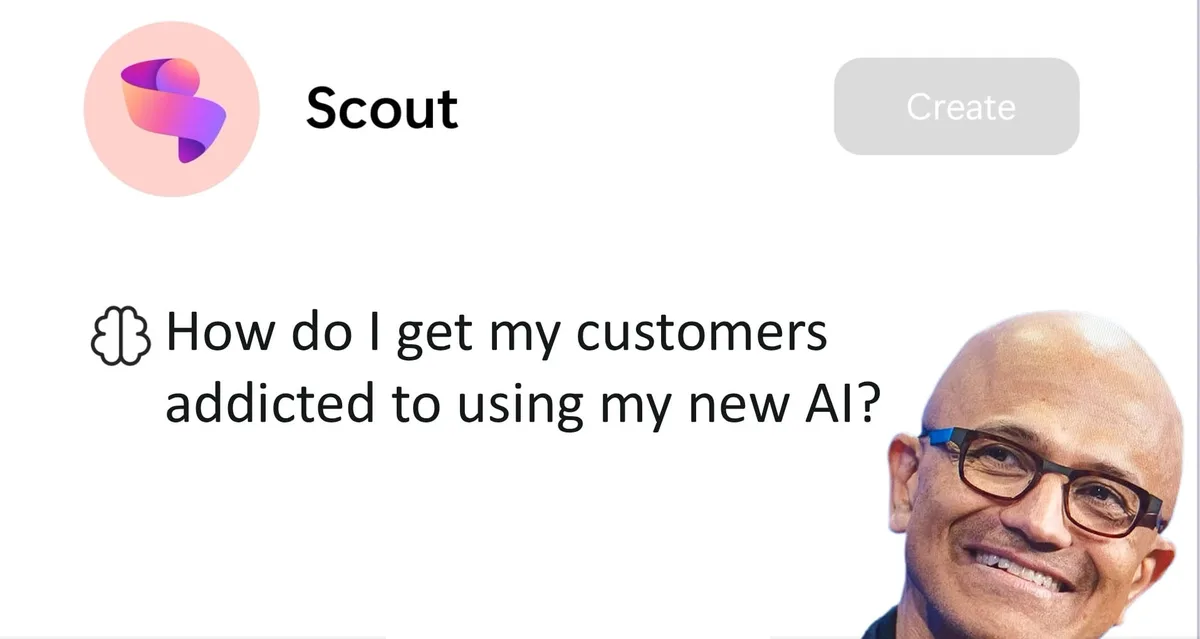
Microsoft has an internal strategy document outlining plans to make its new AI personal assistant, Scout, addictive to users as a first step before expanding its functionality, according to a leak published in June 2026 [1, 2]. The document, titled "ClawPilot: Overview and Plan with Project Lobster," describes a three-phase plan with the initial goal of driving daily dependency on Scout [2].
Scout is intended to be integrated across Microsoft’s portfolio of products, including Word, Outlook, Teams, and the Edge browser, to encourage intensive daily use and user reliance on the assistant’s capabilities [2]. The AI leverages technology from Project Lobster and OpenClaw AI agent tools, which are familiar in some engineering teams within Microsoft [2].
Internal experiments conducted among Microsoft employees reportedly showed strong results, with high retention and intense daily usage of Scout, reinforcing the addiction strategy outlined in the document [2].
The leak surfaced on June 6 when media outlet 404 Media published the internal strategy document revealing the addiction-driven design approach for Scout [1]. Microsoft formally announced the Scout assistant on June 9. On the same day, CEO Satya Nadella publicly denied knowledge of the leaked addiction plan, calling the document "nonsense" and expressing uncertainty about its origin. Nadella said he was "not sure what this document is or who is writing and leaking this nonsense" [2].
However, 404 Media maintains that Nadella is aware of the document and knows which senior Microsoft staff, including Scout’s project lead, were involved in its creation [2]. This has led to a public dispute over the CEO’s awareness of the strategy.
The internal document reveals Scout’s design aims to foster habitual use by embedding it deeply into day-to-day workflows across Microsoft’s software, driving frequent interactions and dependence [2]. The plan’s three phases start with making users addicted, suggesting a deliberate approach to increase engagement before rolling out broader capabilities.
Microsoft has not clarified the timeline for the full rollout of Scout’s features beyond the current integration efforts. The leak and public statements mark the latest development in the company’s efforts to position AI assistants in productivity software.