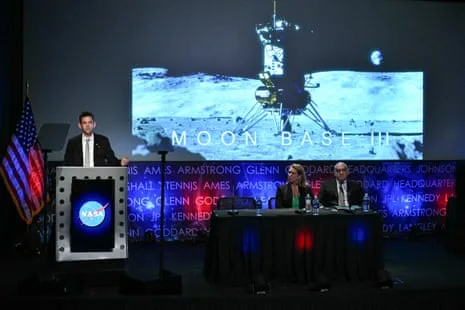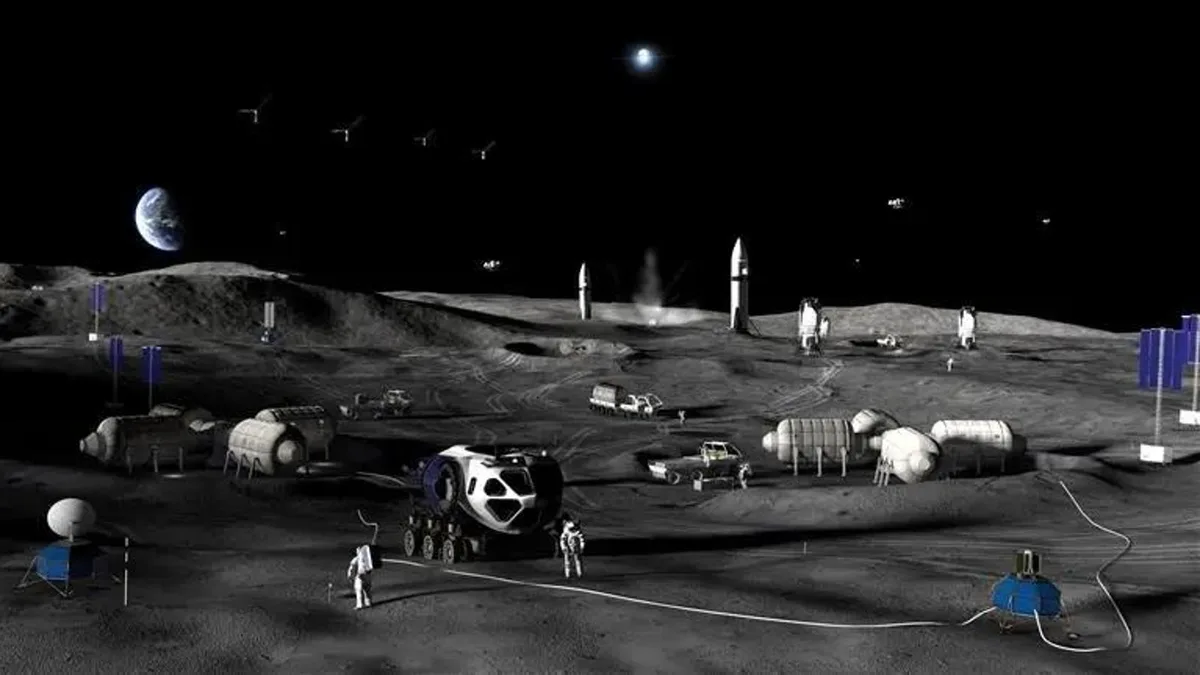
NASA announced plans for three uncrewed lunar missions in 2026 as early steps in building a $20 billion Moon base near the lunar south pole, with the first mission set no earlier than fall 2026 [1, 2, 3]. Blue Origin’s Blue Moon Mark 1 Endurance lander will conduct this initial mission under contracts worth approximately $230 million—though some reports cite $188 million with optional tasks valued at $280.4 million [1, 2, 3]. This mission will deliver scientific payloads to the Shackleton de Gerlache (Connecting) Ridge to test autonomous landing systems, thruster interaction with lunar dust, and other technologies critical for future lunar operations [1, 2, 3].
More than a dozen additional lunar missions are planned in coming years to test rovers, systems, and technologies aimed at supporting future human Artemis missions and long-term surface activity [1, 3]. NASA Administrator Jared Isaacman described the effort as iterative, stating, “We are not jumping right into the glass dome moon base. We intend to take an iterative approach, sending a demand signal to industry for a lot of landers and rovers and tech demonstrations.” He added, “People are looking up again, believing in big things again, and paying attention as America returns to the moon again, and this time to stay” [1]. Isaacman also called the Moon base “America’s and humanity’s first outpost on another celestial world” [2].
Blue Origin was selected over SpaceX for the first uncrewed lunar cargo mission, marking a major moment in the rivalry between Jeff Bezos’s and Elon Musk’s companies [1, 3]. While Blue Origin focuses on cargo landers and lunar surface infrastructure, SpaceX remains involved in NASA’s Artemis program primarily for future crewed lunar landings using its Starship Human Landing System [1, 3].
NASA’s Moon base effort partly responds to geopolitical competition in space, especially China’s goals to land astronauts on the Moon by 2030 and establish a base by 2035 [2].
The initial launch is targeted for fall 2026, with Blue Origin’s Blue Moon Mark 1 Endurance lander set to deliver payloads to the Moon’s south pole region as the first step in the larger Artemis and Moon base campaign [1, 2, 3].