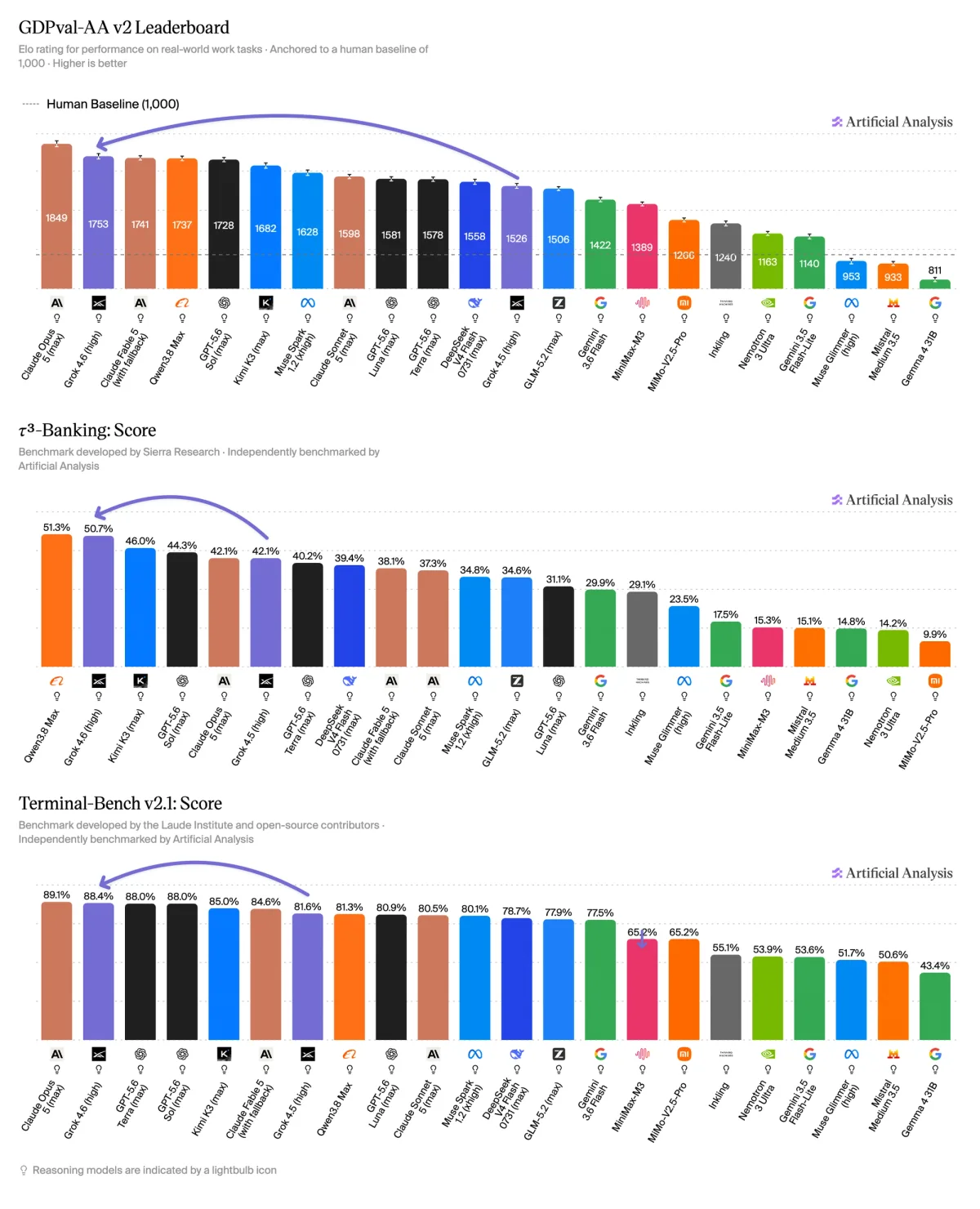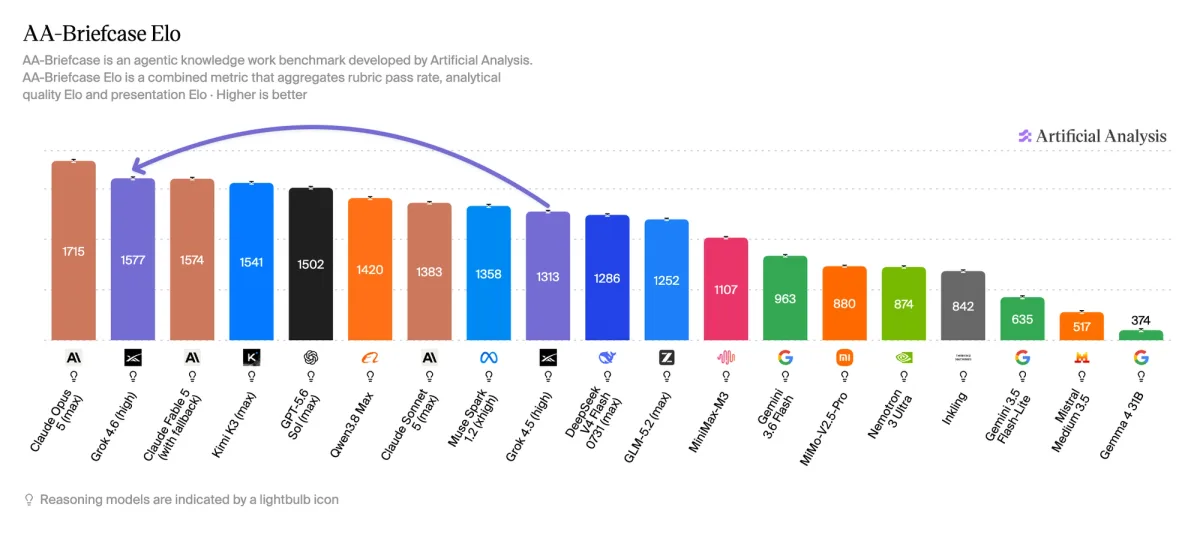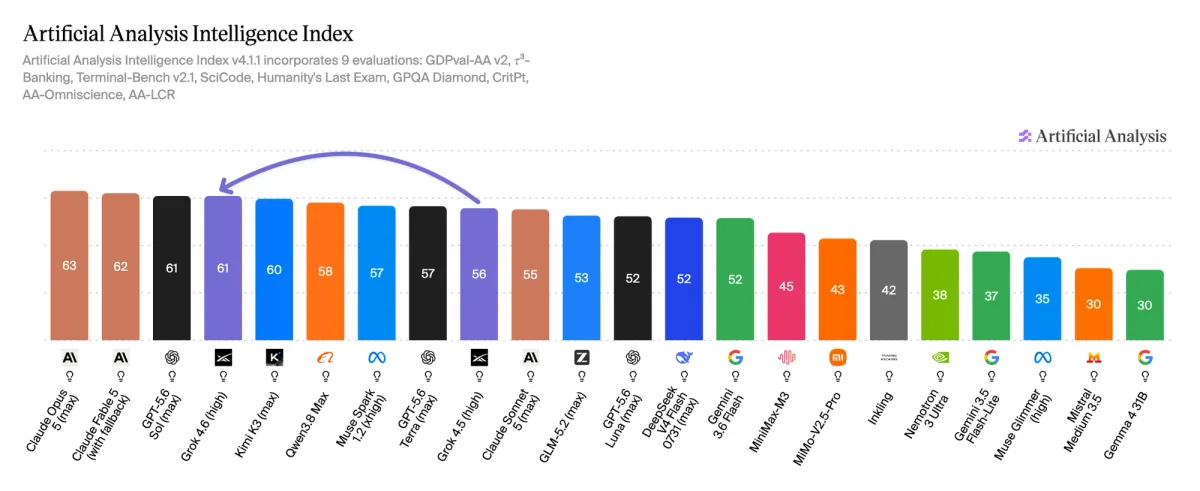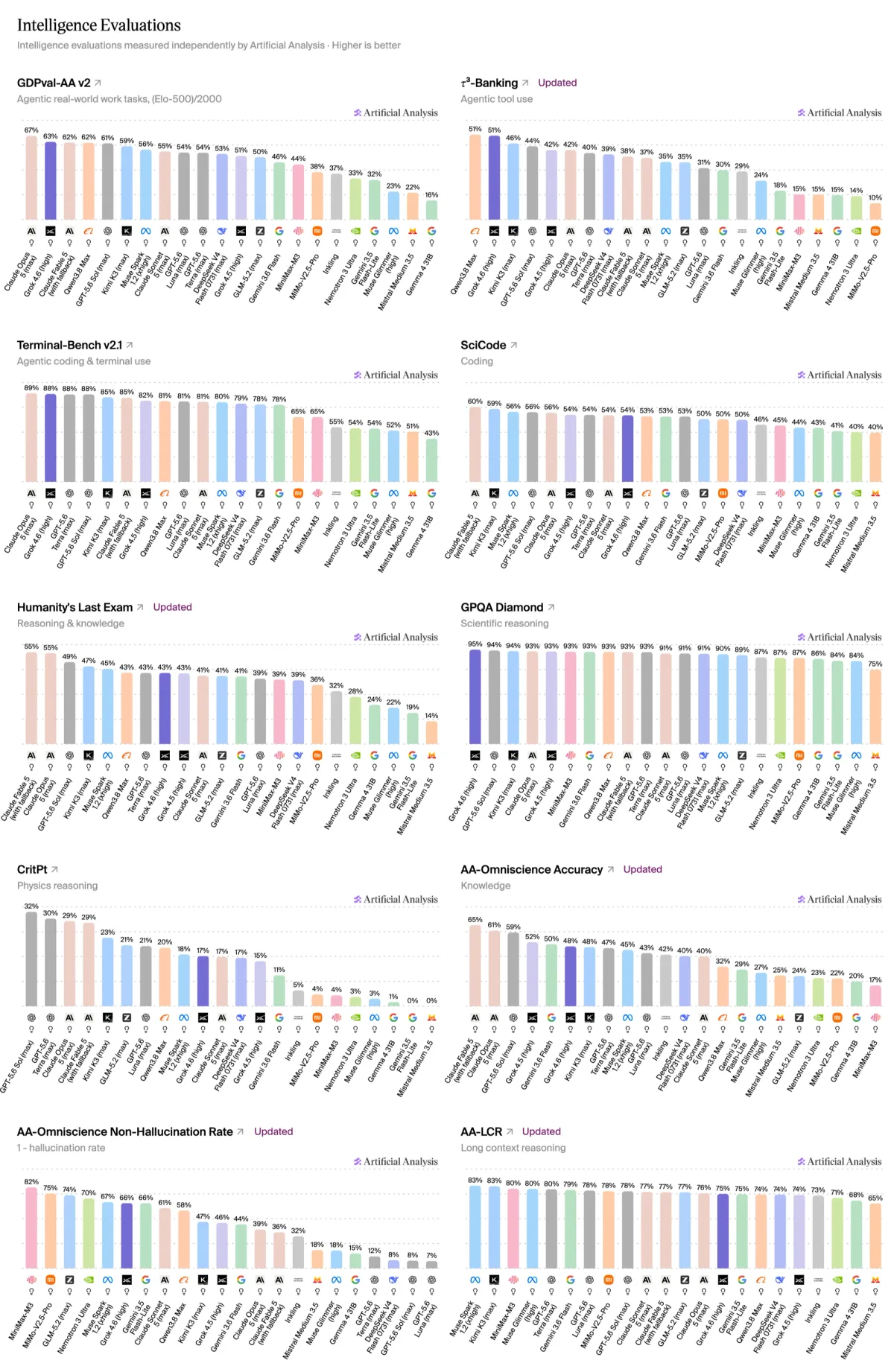
SpaceXAI released Grok 4.6 in July 2026, a large language model that scored 61 on the Artificial Analysis Intelligence Index, placing it on par with OpenAI's GPT-5.6 Sol and just behind Anthropic's Claude models on the intelligence frontier [1, 2]. The model achieved a 5-point improvement over its predecessor Grok 4.5 [1].
Grok 4.6 demonstrates strong agentic performance, excelling particularly in multi-turn tasks and benchmarks related to software, such as coding challenges [1, 3, 2]. It scored 69.9% on CursorBench v3.2, surpassing GPT-5.6 Sol Max but falling just short of Anthropic’s Fable 5 Max, which scored 70.5% [3]. The model’s training used an innovative method combining reinforcement learning with model-generated data, improving its ability to catch and fix coding mistakes during task execution [3].
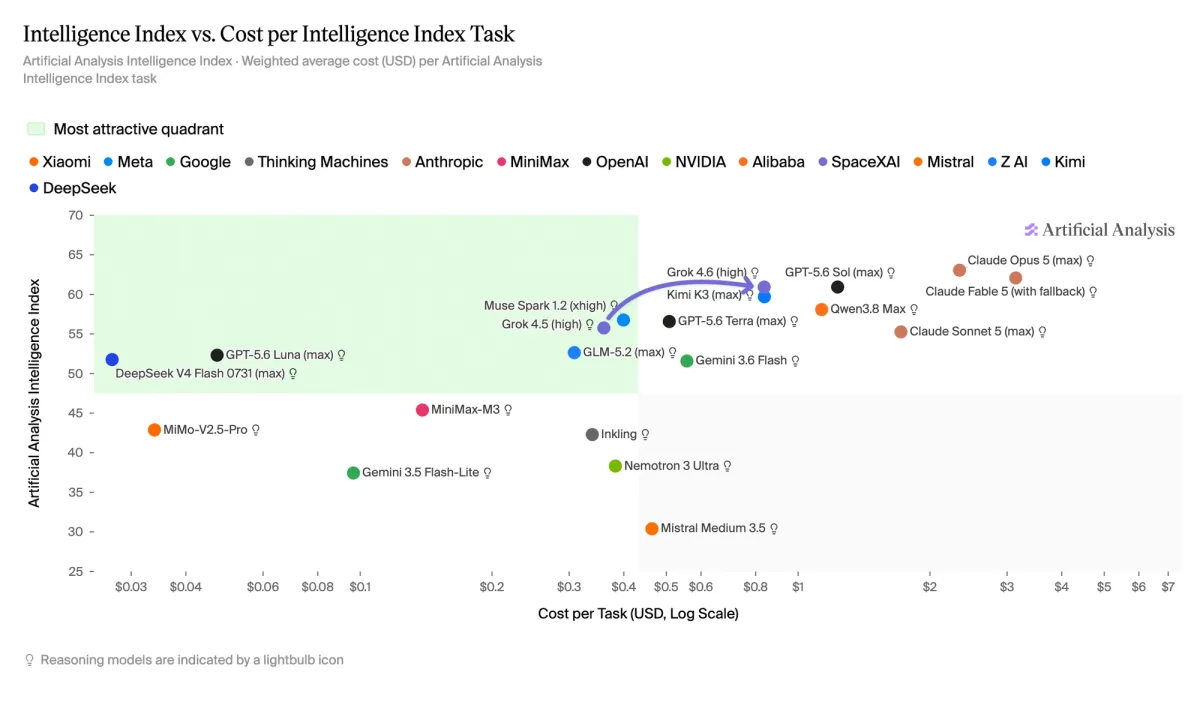
Cost efficiency is a key aspect of Grok 4.6. It charges $2 per million input tokens and $6 per million output tokens, making it over 60% cheaper than Claude Opus 5 and GPT-5.6 Sol [1, 2]. The average cost per task stands at roughly $0.84, giving Grok 4.6 a competitive edge in balancing performance with expenses [1, 2]. Elon Musk tweeted that Grok 4.6 "客觀上排名第一 (objectively ranks first) in intelligence, speed, and cost," underscoring the company's confidence in the model's market position [2].
Gavin Baker, an industry analyst, noted that Grok 4.6’s performance "roughly matches Fable 5 Max while offering up to 85% cost discount" in token pricing [2]. However, some experts point out that while Grok 4.6 has improved notably over its predecessors, Anthropic’s Fable 5 Max still leads in several coding benchmarks [3].
Meanwhile, Google’s Gemini AI continues to dominate with over 1 billion monthly active users [2]. Google recently postponed the release of Gemini 3.5 Pro after internal tests revealed lagging performance in code development compared to competitors [2]. On August 5, 2026, Google DeepMind appointed Koray Kavukcuoglu as new head to accelerate AI progress and better integrate Gemini into products [2].
Separately, Twitch (part of Amazon) confirmed on August 12, 2026, that it uses livestream content to train AI models, providing an opt-out option for users. Twitch’s community lead Mary Kish acknowledged that "users are expected to react negatively," while product head Mike Minton noted that "almost all public content is used for model training regardless of explicit permission" [2].
SpaceXAI’s Grok 4.6 launch follows a rapidly evolving AI landscape, with the model now available as a competitive, cost-effective alternative for developers and businesses working on multi-turn and coding tasks.