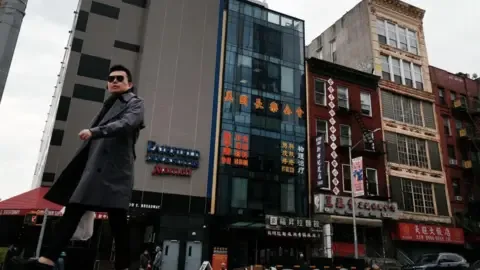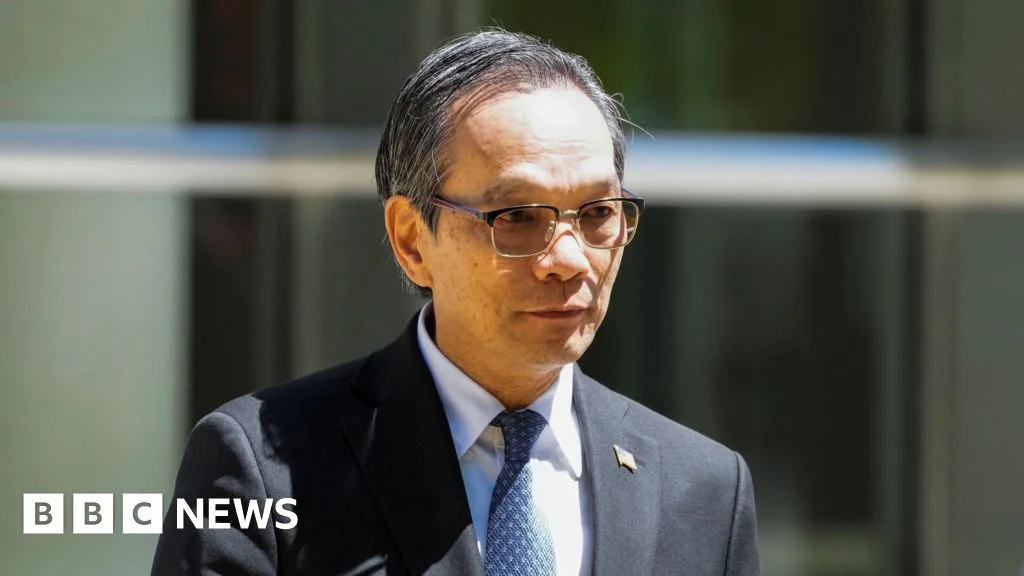
In 2022, 64-year-old Chinese community leader Lu Jianwang opened an office in Manhattan's Chinatown to assist Chinese expatriates with driver's license renewals and social activities like ping pong [1, 2, 3]. The FBI raided the office and charged Lu with acting as an unauthorized foreign agent by establishing a covert overseas police station for China [1, 2, 3]. Prosecutors allege Lu used the office to conduct surveillance on critics of China, including verifying the residence of dissident Xu Jie in the US [2, 3]. Lu Jianwang was found guilty in US court in May 2026 and faces up to 30 years in prison [1, 2, 3]. His co-defendant Chen Jinping admitted to assisting in establishing the center and acting as an unauthorized foreign agent [2, 3].
Arcadia Mayor Eileen Wang pleaded guilty days before Lu’s verdict to posting propaganda targeting Chinese Americans on behalf of the Chinese government [1, 2, 3]. Wang's role demonstrates Beijing's strategy to use local figures to disseminate positive narratives, including denying allegations of abuse in Xinjiang [2, 3]. The US cases came the same week former President Donald Trump met with Chinese President Xi Jinping in Beijing, avoiding topics like espionage and focusing on trade [1, 2, 3].
China is alleged to have established over 100 overseas police stations in at least 53 countries worldwide, used for covert surveillance and control over overseas Chinese communities [1, 3]. Beijing denies these stations exist or describes them as volunteer administrative centers serving Chinese citizens abroad [2, 3]. An investigation found no criminal activity in some locations [3]. Experts call these operations part of a strategic effort to suppress dissent and shape narratives internationally. Lauryn Williams, deputy director at CSIS, said, "It's part of the same sort of strategic approach, which is to tamp down on dissent and to shape a clear narrative around the PRC, and to do that in bolder ways, as we're seeing." [1]
Former CIA officer Douglas London described Chinese espionage as "a scaled industry," involving surveillance, cyberattacks, and theft of military and tech secrets [2, 3]. He said China views harsh suppression of overseas dissent as necessary to protect national stability and sees Western support for dissidents as attempts to undermine China [2, 3]. Williams added, "From these cases this week, I do not think such activities have subsided." [2]
Lu Jianwang’s lawyer John Carman said the office's purpose was not espionage but routine services, stating, "This is not 'spy moment,' it is about driver's license renewals." [2]
The next step in Lu Jianwang’s case is sentencing, where he could face up to three decades in prison for his role acting as an unauthorized foreign agent for China [1, 2, 3].