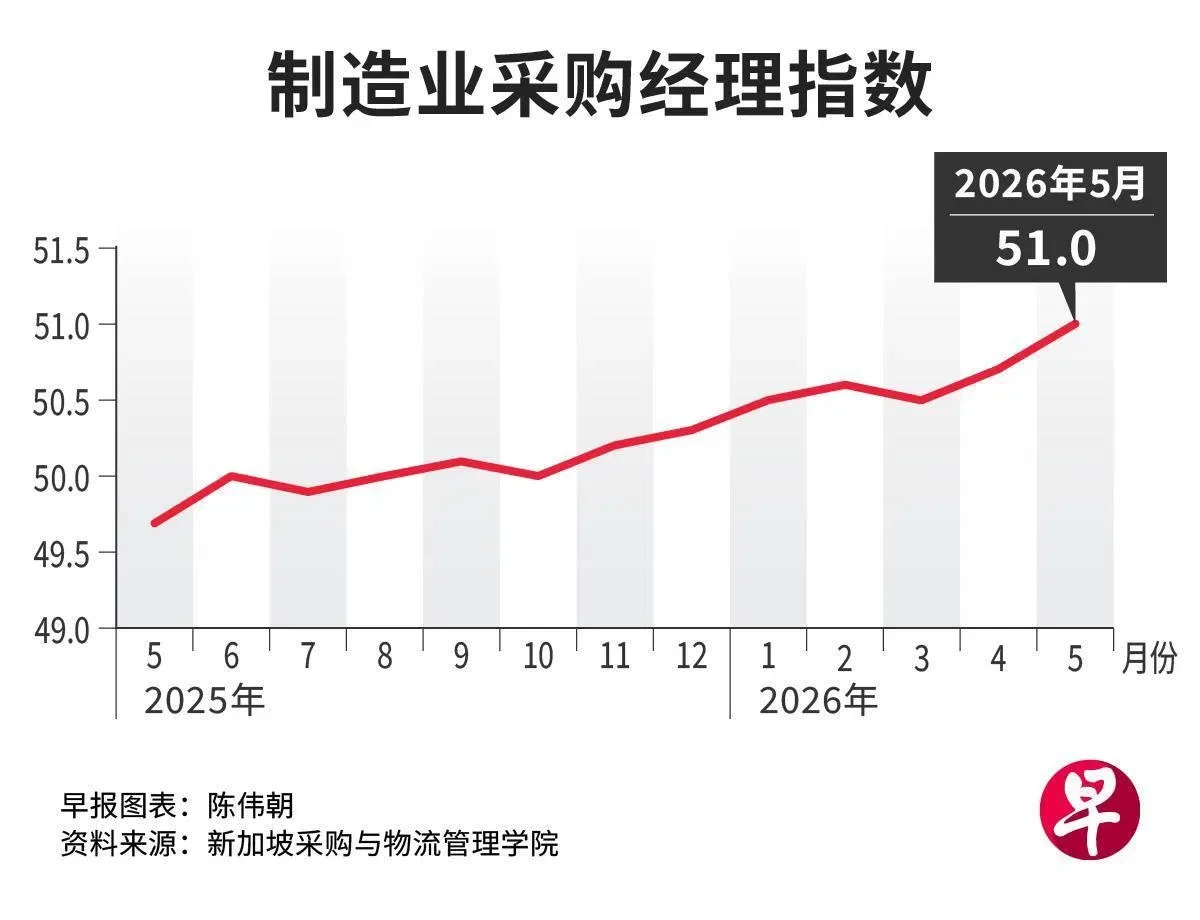
Singapore's manufacturing sector expanded in May as the overall Purchasing Managers' Index (PMI) rose 0.3 points to 51.0, marking the 10th straight month of growth and the highest reading since December 2024, the Singapore Institute of Purchasing and Materials Management reported on June 2 [1, 2, 3, 4].
The electronics sector led the gains with its PMI climbing 0.2 points to 51.9, extending a 12-month growth streak and reaching levels unseen since August 2018 [1, 2, 3, 4]. A PMI above 50 signals expansion, indicating sustained demand growth in both manufacturing and electronics segments [1, 2, 3, 4].
Growth was supported by strong demand driven by an upturn in AI technology applications, fueling the production of electronics and related components [1, 2, 3, 4]. Stephen Poh, Executive Director of SIPMM, said the "latest figures point to a continued positive outlook for the overall manufacturing sector, supported by robust demand from the AI-driven technology up-cycle." He added that despite margin pressures from rising input costs and slower supplier deliveries, the increase in order backlogs and improving business sentiment suggested cautious optimism among manufacturers [2].
However, supplier delivery indices contracted further in May, with manufacturing supplier deliveries shrinking for the 5th consecutive month and electronics for the 7th, illustrating persistent supply chain challenges and extended shipping times [1, 3, 4]. Rising input costs and these delays continued to strain profit margins and operational efficiency [1, 2, 3, 4]. OCBC Chief Economist Selena Ling warned of "a real supply constraint on future activity pipelines if the sourcing of intermediate components cannot keep pace with the demand conditions" [2].
Reflecting strong demand, finished goods inventories declined, raising concerns about potential supply shortages ahead [2]. UOB Associate Economist Jester Koh noted that May's order backlog and finished goods data showed electronics production was lagging demand but saw scope for capacity utilization improvements that could boost output in coming months [2].
Broader regional data showed ASEAN's manufacturing PMI rose to 51.5 in May, the first acceleration in three months and extending the 11-month expansion trend [1]. Economic forecasts for Singapore were upgraded with 2026 GDP growth now expected at 3.5%, based on strong indicators including manufacturing [1].
Economists pointed to similar gains in South Korea and Taiwan powered by AI demand, suggesting Singapore’s manufacturing sector may continue to benefit from the regional technology cycle [1]. The Middle East conflict has meanwhile added pressure to input costs and supply chains, further complicating operational conditions [1, 2].
The Singapore Institute of Purchasing and Materials Management is expected to release June PMI data in early July, which will reveal whether supply bottlenecks ease and sector growth maintains momentum [1, 2, 3, 4].